
Before a digital health tool reaches the clinic, it needs to be tested in realistic conditions. Our clinical simulation infrastructure and expertise help make that happen.
The clinical simulation lab is a flexible research and testing environment at Melbourne Connect, designed to support digital health, AI, health services research, and the piloting of the future of medical education.
It includes clinical, observation and codesign spaces supported by expertise in clinical simulation for research, digital sandbox infrastructure, computers, displays, recording equipment, screen casting and teleconferencing facilities.
The lab supports the de-risking of new innovations through early exploration of usability, feasibility, and acceptability with clinical staff, patients, carers, and other members of the community.
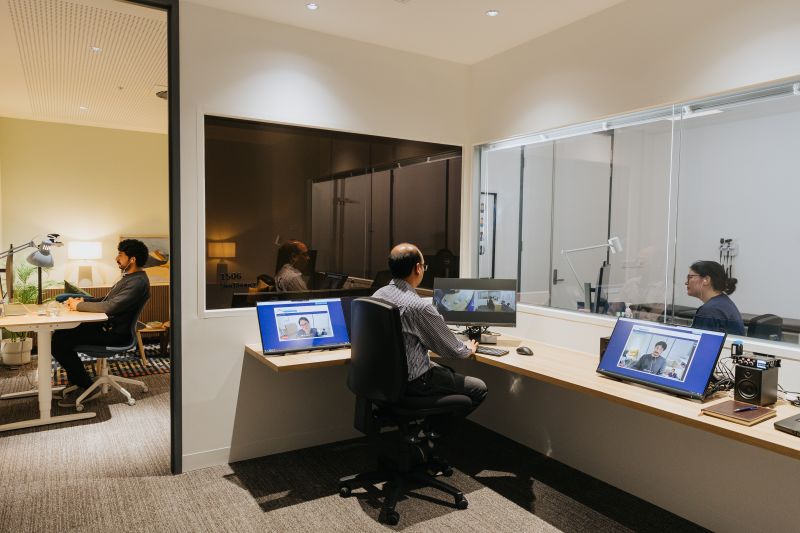
Inside the lab
The lab brings together realistic clinical and home-like simulation settings with digital research infrastructure, including a digital sandbox to host and run clinical software, the BLISS mixed reality simulation space, and the HAI-TEAM platform for exploring human-AI collaboration through simulation – all in one connected facility.
Teams can move between scenario-based testing, observation, recording, screen sharing, group codesign and hybrid participation without needing to set up separate spaces or systems.
The lab provides end-to-end support for recruiting clinical users, consumers, community members, and actor participants.
Lab users can also access methodological expertise in clinical simulation for research at the Centre for Digital Transformation of Health, either for informal advice or as partners in research.
How can the SimLab support your work?
Validate digital health tools before implementation
Test digital health tools in realistic, controlled conditions before clinical deployment – reducing risk and building confidence in your solution. For researchers, clinicians, students and project teams working on digital health, clinical simulation, technology evaluation or stakeholder engagement.
Test clinical workflows before real-world implementation
Use the SimLab to trial digital tools, care pathways or service models in realistic but controlled conditions. Clinicians, hospitals and industry partners can observe how technologies interact with people, workflows and clinical settings before wider deployment. For clinicians, hospitals and industry partners.
Strengthen grant proposals with pre-pilot evaluation
Use the SimLab to build a stronger pathway from R&D to first clinical pilot by generating early evidence on usability, feasibility, acceptability, workflow fit, and implementation risk. Pre-implementation validation can help demonstrate that your project has a credible de-risking strategy, a clearer route to translation, and a distinctive capability that strengthens its case for funding. For researchers, project teams, and partners developing grants or translational research proposals
Pilot the future of medical education
Design, pilot, and evaluate immersive blended learning environments – from mixed reality teaching scenarios to interprofessional simulation. For academic educators, curriculum designers, and clinical educators.
Our capabilities
When you engage the clinical simulation lab, you gain access to a connected suite of capabilities – including the BLISS immersive environment, dedicated consumer and community involvement support, a digital sandbox, and the academic expertise of our team and collaborators.
-
Research experts
Advisory services to help design, refine and de-risk digital health studies, support for grant applications from conception through submission, and practical tools and resources to bring your research to life.
-
Consumer and community involvement
Specialist advice, networks, and support to embed the consumer voice across your research.
-
BLISS interactive environment
BLISS is a state-of-the-art, interactive projection-based simulation suite that puts users in a fully immersive, responsive environment.
-
Human-AI Teaming Simulation Platform for Clinical Research
HAI-TEAMSim is a configurable research platform to understand how clinicians think, decide, and team with AI.
Clinical simulation in action
-
Optimisation of an opportunistic mental health screening care model for general practice
-
Eliciting user and purchaser insights to de-risk Australian market entry for a diabetes management platform
-
Simulation testing of a cancer risk decision support tool for general practice
-
Simulation testing of a clinical decision support tool for early pancreatic cancer detection in general practice
How to get started →
Whether you're coming with a fully formed project or just an early idea, we'll work with you to find the right approach.
-
- Set up a personalised discussion and facility tour with Centre staff
- Discuss project goals, audiences, and intended outcomes
- Access support to refine ideas into a feasible simulation project
- Access advice on consumer involvement, research methods, and evaluation approaches
-
- Collaborate on scenario design, development, and technical configuration
- Set up the digital content, workflows, equipment, and environments needed for your simulation
- Connect you with specialist technical and design experts to support your project
-
- Delivery of onsite technical and operational support during simulation sessions
- Guidance on interpreting results and identifying key insights
-
- Prepare publications, reports, and grant applications
- Identify opportunities for implementation, future testing, funding opportunities, and partnership development
- Connect you with relevant researchers, clinicians, industry partners, consumers, and community groups
FAQs
-
The clinical simulation lab is a flexible research and testing environment at Melbourne Connect. It supports realistic simulation, user experience testing, software demonstrations and digital health research across clinical, home-like, observation and codesign spaces.
-
The lab brings realistic clinical and home-like simulation environments together with practical research infrastructure in one connected facility. Teams can test tools, observe workflows, capture data, run codesign sessions and support hybrid participation without setting up separate spaces or systems.
-
The lab is accessible to University researchers, clinicians, educators, students and project teams working on digital health, clinical simulation, technology evaluation or stakeholder engagement. Hospitals, industry partners and external collaborators may also use the space by arrangement with the SimLab team.
-
The lab brings together physical simulation spaces and digital research infrastructure in one connected facility:
Space or capability Description GP consultation room A flexible consultation-style room for realistic clinical encounters, software demonstrations and digital health testing Hospital room A hospital-style simulation room including the BLISS immersive environment, hospital bed, and computer on wheels Patient home environment A home-like setting for exploring how digital health tools and services may be used outside formal clinical settings Human-computer interaction observation rooms Observation and control spaces for usability testing, with video, audio, and screen recording capability Codesign and workshop space A configurable area for group sessions, stakeholder engagement, demonstrations and collaborative design activities Digital sandbox A configurable environment for safe testing of digital health tools within a simulated clinical and technical ecosystem Methods advice and academic partnership Access to academic expertise in digital health simulation, from informal advice through to formal research collaboration -
Engagements usually begin with discovery and project planning, followed by simulation design and development, simulation delivery and evaluation, and then translation, impact and scale-up. The SimLab team can help shape the right approach depending on the research question, audience, technology or workflow being tested.
-
Research projects using the lab may require ethics approval depending on the project design, participants, data collection methods and intended use of results. Project teams are responsible for confirming and obtaining the appropriate approvals before research activity begins.
-
The lab is located on Level 1 at Melbourne Connect and is fully accessible by elevator. Nearby facilities include a kitchenette and all-gender accessible washroom and baby change space. Accessibility needs should be discussed with the SimLab team during planning so the session can be set up appropriately.
-
To discuss a potential project, collaboration or tour, contact our research team with a brief outline of what you would like to test, demonstrate or explore. The team can help confirm whether the lab is suitable and advise on next steps.