Galaxy Resources
Galaxy Resources
Overview
Galaxy Australia is a nationally funded, web-based platform for accessible, reproducible, and transparent computational biomedical research. The benefits of Galaxy Australia include:
- No cost for researchers to use, as it is a fully subsidised service with long term national funding.
- Enables users without programming experience to easily run individual bioinformatics tools as well as larger workflows.
- Captures data processing/analysis details so that users can repeat and understand complex computational analysis.
- Enables users to share and publish analyses via the web.
- Underpinned by nationally supported high performance computing infrastructure, configured to support all manner of computationally intensive bioinformatics data analysis.
- Can be used to analyse a broad variety of data types and data sources. These can include de-identified human data. All data uploaded to and processed on Galaxy Australia remains within Australia (no data is transferred overseas).
- Offers workbenches tailored for research domains through Galaxy Labs (there are Labs currently available and tailored for the domains of Genomics, Proteomics, Single Cell and Microbiology).
- Has an extensive library of free online training materials.
- Has supported over 600 scientific publications since 2020, including in Science, Nature Plants, Nature Communications and GigaScience.
More details are available in this flyer (download from Zenodo) created in 2023 by the Australian BioCommons, who run the Galaxy Australia platform.
Acknowledgements
Melbourne Bioinformatics
Melbourne Bioinformatics requests that the following acknowledgement statement be included in publications (e.g. journal articles or thesis) resulting from research supported by Melbourne Bioinformatics (replacing "AUTHORS(S)" with the author names).
- "AUTHORS(S) would like to acknowledge Melbourne Bioinformatics, Faculty of Medicine, Dentistry and Health Sciences at University of Melbourne for its support while conducting the research presented in this work."
Galaxy Australia
When you use Galaxy Australia in support of your publication or project, please acknowledge its use with the following acknowledgement statement.
- "This work is supported by Galaxy Australia, a service provided by Australian BioCommons and its partners. The service receives NCRIS funding through Bioplatforms Australia, as well as The University of Melbourne and Queensland Government RICF funding."
Please also cite the Galaxy publication.
- The Galaxy Community, The Galaxy platform for accessible, reproducible, and collaborative data analyses: 2024 update, Nucleic Acids Research, Volume 52, Issue W1, 5 July 2024, Pages W83-W94, https://doi.org/10.1093/nar/gkae410
See the Best Practices for Citing Galaxy tutorial for a guide on how to cite Galaxy in your publications and prepare your Methodology based on your Galaxy history.
Support
Melbourne Bioinformatics employs full-time support through Tristan Reynolds (Galaxy Outreach Specialist) for helping Galaxy Australia users. Email treynolds@unimelb.edu.au or contact us to arrange a one-on-one discussion about how you can use Galaxy Australia in your research, a seminar or a training session.
In addition to our regular Galaxy-based workshops, we can also provide training tailored to the specific needs of individual research groups. Support is available for using Galaxy Australia in formal coursework teaching and for setting up research analysis in Galaxy Australia, including
- Uploading and using datasets
- Selecting analysis tools
- Creating analysis pipelines (Galaxy workflows)
- Liaising with the Galaxy Australia team where necessary to resolve tool errors
- Requesting increased data storage quotas
- Requesting new tools and new reference datasets
Eligibility
Our Galaxy Australia training and support is available to researchers and students from the University of Melbourne and its affiliated research institutes.
Published Tutorials
The Galaxy Training Network contains an extensive range of Galaxy training material and resources. On this page you can find links to all of the published Galaxy Training Network tutorials that Melbourne Bioinformatics has contributed to.
Scientific Analysis
-
-
- Unicycler Assembly
- Vertebrate genome assembly using HiFi, Bionano and Hi-C data - Step by Step
- Genome Assembly of a bacterial genome (MRSA) sequenced using Illumina MiSeq Data
- An Introduction to Genome Assembly
- Hybrid genome assembly - Nanopore and Illumina
- De Bruijn Graph Assembly
- Large genome assembly and polishing
- Chloroplast genome assembly
- Genome Assembly of MRSA from Oxford Nanopore MinION data (and optionally Illumina data)
- Unicycler assembly of SARS-CoV-2 genome with preprocessing to remove human genome reads
- Deeper look into Genome Assembly algorithms
-
-
-
-
-
-
-
Galaxy Platform and Data Principles
-
- Reference Data with Data Managers
- Galaxy Installation with Ansible
- Running Jobs on Remote Resources with Pulsar
- Galaxy Monitoring with Reports
- Upgrading Galaxy
- Reference Data with CVMFS
- Reference Data with CVMFS without Ansible
- Galaxy Interactive Tools
- Training Infrastructure as a Service (TIaaS)
- External Authentication
- Mapping Jobs to Destinations using TPV
- Distributed Object Storage
- Performant Uploads with TUS
- Galaxy Monitoring with Telegraf and Grafana
- Ansible
- Galaxy Monitoring with gxadmin
- Galaxy Tool Management with Ephemeris
- Connecting Galaxy to a compute cluster
- Galaxy Database schema
- Enable upload via FTP
- Automation with Jenkins
- Use Apptainer containers for running Galaxy jobs
- Data Libraries
- Reference Genomes in Galaxy
- Storage Management
- Galaxy Monitoring
- Empathy
- Server: Other
- Galaxy from an administrator's point of view
- Server Maintenance: Cleanup, Backup, and Restoration
- uWSGI
- Galaxy Troubleshooting
- Galactic Database
- Advanced customisation of a Galaxy instance
- Galaxy on the Cloud
-
-
-
Published Workflows
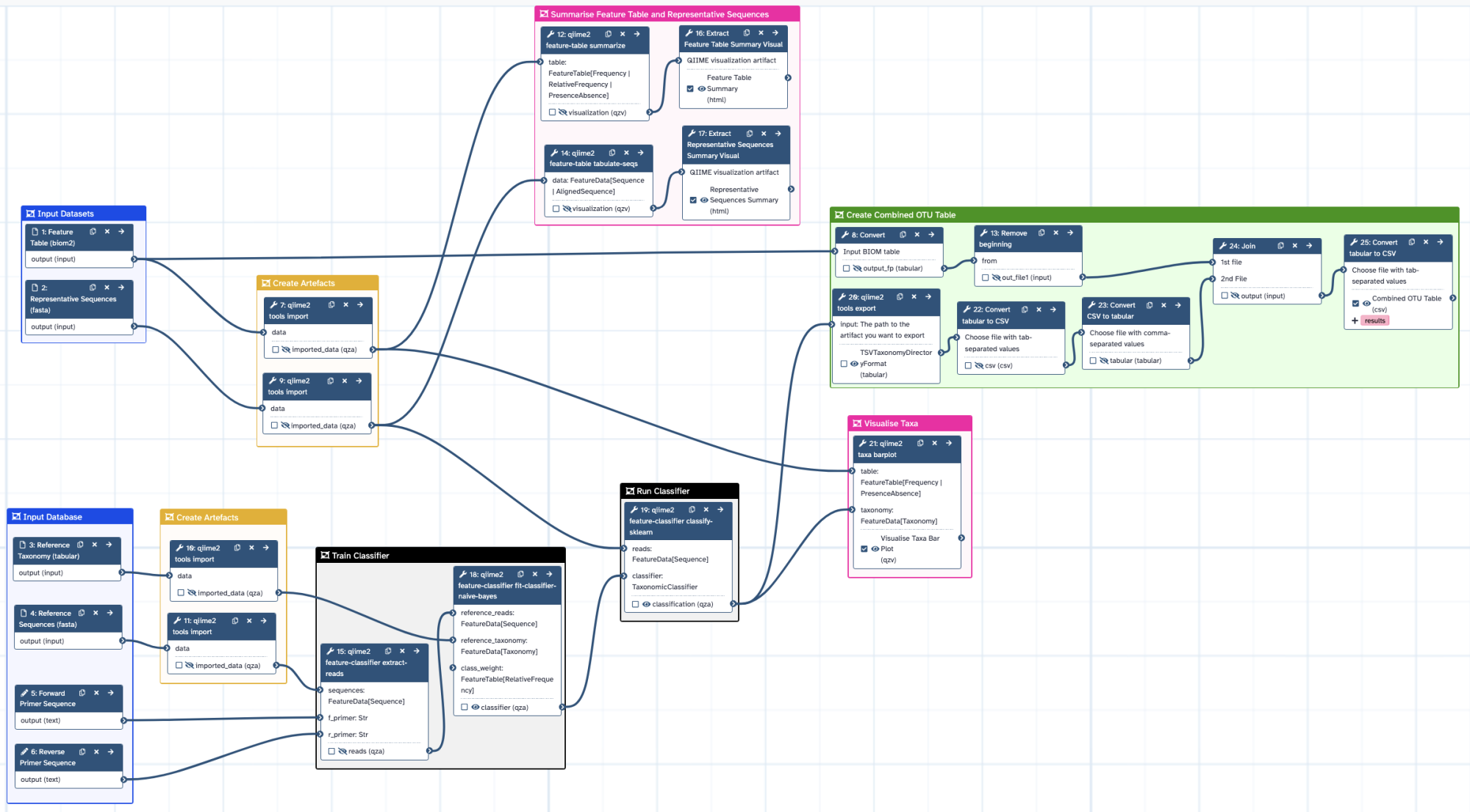
Example Galaxy Workflow (Taxonomy Assignment with QIIME2)
Publishing Galaxy Workflows
Galaxy workflows can be exported and published to a number of online repositories:
The Galaxy Training Network (GTN) also contains Galaxy workflows that are associated with specific GTN tutorials. Workflows published and accessed through any of the above repositories can be downloaded and imported into Galaxy Australia.
On this page you can find links to published Galaxy Workflows that were developed with support from Melbourne Bioinformatics.
-
- Unicycler training (WorkflowHub, GTN)
- Intro to Genome Assembly (WorkflowHub, GTN)
- VGP assembly: training workflow (WorkflowHub, GTN)
- Chloroplast genome assembly and annotation (WorkflowHub, GTN)
- Assembly polishing - upgraded (WorkflowHub, GTN)
- Assembly with Flye - upgraded (WorkflowHub, GTN)
- Assess genome quality - upgraded (WorkflowHub, GTN)
- Combined workflows for large genome assembly - upgraded (WorkflowHub, GTN)
- Data QC - upgraded (WorkflowHub, GTN)
- Racon polish with Illumina reads (R1 only), x2 - upgraded (WorkflowHub, GTN)
- Racon polish with long reads, x4 - upgraded (WorkflowHub, GTN)
- Trim and filter reads - fastp - upgraded (WorkflowHub, GTN)
- kmer counting - meryl - upgraded (WorkflowHub, GTN)
- Hybrid Genome Assembly Tutorial Workflow (WorkflowHub, GTN)
- Genome Assembly of MRSA using Illumina MiSeq Data (WorkflowHub, GTN)
- Debruijn Graph SPAdes Assembly (WorkflowHub, GTN)
- Debruijn Graph Velvet Full and SPAdes Assembly (WorkflowHub, GTN)
- Debruijn Graph Velvet Optimiser and SPAdes Assembly (WorkflowHub, GTN)
- Genome Assembly of MRSA using Oxford Nanopore MinION (and Illumina data if available) (WorkflowHub, GTN)
-
- Checking expected species and contamination in bacterial isolate (WorkflowHub, GTN)
-
- Hi-C Analysis with Galaxy Tutorial Workflow (WorkflowHub, GTN)
- GTN - ChIP Seq - Formation Of Super Structures On Xi (WorkflowHub, GTN)
- ATAC-seq GTM (WorkflowHub, GTN)
-
- Genome Annotation with Prokka (WorkflowHub, GTN)
- mrsa AMR gene detection (WorkflowHub, GTN)
-
- Assembly of metagenomic sequencing data (WorkflowHub, GTN)
- Metagenomic Binning (WorkflowHub, GTN)
- Taxonomic Profiling and Visualization of Metagenomic Data (WorkflowHub, GTN)
- Taxonomy Assignment with QIIME2 (WorkflowHub)
- Viral Amplicon Analysis Pipeline for ONT Data (WorkflowHub)
- MPXV (Mpox) Phylogenetic Analysis with Squirrel (WorkflowHub)
-
- Galaxy Intro Short (WorkflowHub, GTN)
- GTN - Sequence Analyses - Mapping (WorkflowHub, GTN)
- Quality and contamination control in bacterial isolate using Illumina MiSeq Data (WorkflowHub, GTN)
-
- Microbial Variant Calling (WorkflowHub, GTN)
- TB variants tutorial main workflow (WorkflowHub, GTN)
- TB Variant Analysis v1.0 (WorkflowHub, GTN)