Could your digital health breakthrough deepen inequity?
 Dr Mahima Kalla Follow 8 min read · August 26, 2025
In this microlearning, you will:
- Understand that all digital health technologies have social and equity implications, and that in developing and implementing these technologies, we may inadvertently exacerbate health disparities.
- Understand that since society and health systems are unequal, the data they produce is also biased and inequitable
- Describe three ways that we can ensure more equitable digital health tools.
This microlearning is a part of a set of learnings in our Project Incubator. If you enjoy this learning, please explore The Validitron page to see how you can develop your digital health project with us and the Learn page to see our other education offerings.
A lesson in unintended consequences
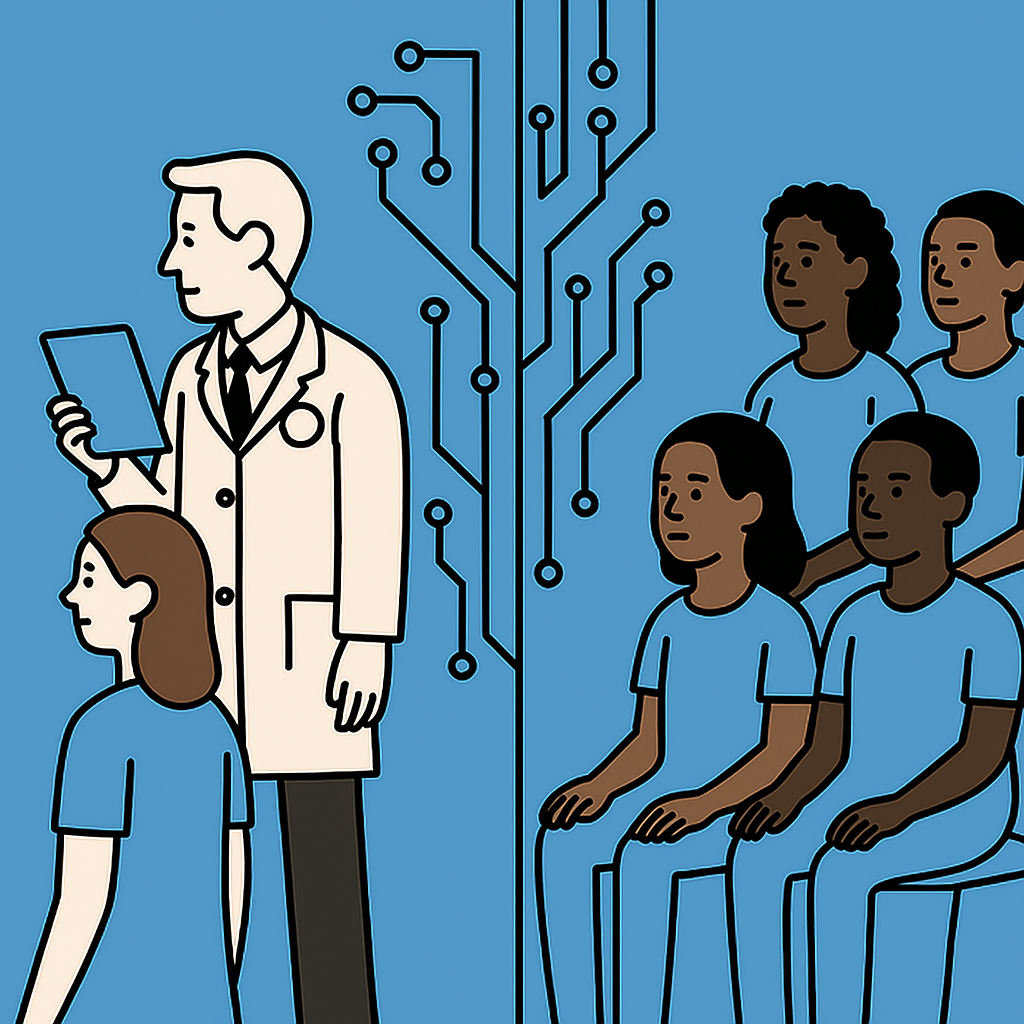
When biased data is fed into AI models, the consequences can be life-threatening. An AI algorithm used in many US hospitals was designed to find very sick patients to give them access to more healthcare. But researchers discovered after implementation that it gave black patients lower scores than white patients who were just as sick.[1]
The problem happened because the algorithm judged “who needs more care” based on the amount of money spent on their past health care. Since black patients often get less medical treatment, due to barriers like discrimination, lower trust in the system, and less access to care, their costs were lower — even though their health problems were often worse.
As a result, black patients had to be sicker than white patients before the program flagged them for extra support. Researchers showed that if the program was adjusted to use better measures of health, many more black patients would have received the help they needed.
Let's see what we can do to ensure this never happens to one of your projects.
Address equity over the lifecycle of development
Build a diverse team of developers, including consumers with lived experience, and consult digital health equity experts on systemic inequities to overcome limitations with the datasets and avoid reinforcing existing inequity.
Before the development of a digital health tool, consider that digital health equity can impact us at individual, interpersonal, community, and societal levels [2]. Not everyone has the capacity, access, and ability to use digital health tools. Select each card to learn more:
Because of these factors, 1 in 10 Australians are digitally excluded.[3] Certain populations have even higher rates of digital exclusion, such as older adults, Indigenous Australians, rural and regional Australians, and those with lower socio-economic status.
 Incubator activity
Think about what groups your tool will target:
- Make a list of the groups your tool is most likely to benefit, and then a list of groups who might be left out.
- Thinking about capacity, access, and ability, what barriers might these groups face in accessing or using your tool (internet, cost, literacy, trust)?
- What modifications will you make, and what implementation strategy will you need to ensure they can access and use it?
During the development of a digital health tool, use co-design and other participatory methods to hear the voices of individuals and groups who are at risk of inequity. This can be done by co-designing digital health tools specifically for vulnerable groups, or modifying existing interventions for a broader range of individuals.
Rural and regional Australians experience unique challenges with digital access, health access, and health outcomes. Let's look at a scenario and see how building a diverse team can influence the development of a digital tool. Select the next arrow to complete the scenario and check your understanding with a quick quiz question.
After the development of a digital health tool, you can sense check with vulnerable groups whether your tool is inclusive and meets their unique needs.
Incubator activity
Identify who's on your team, and who you would like on your team?
- Map your current team or network of contacts for your project. Whose perspectives are present, and whose are missing?
- Identify at least one consumer or community group with lived experience of inequities and plan how you could involve them in co-design.
- Reach out to a digital health equity expert, clinician, or local advocacy group who could act as an advisor.
AI and bias in health data
Be aware that until inequity in the health system is eradicated, all of the healthcare data that feeds AI algorithms will be unrepresentative, missing important information, or biased.

In other words, healthcare data is evidence of the inequity that already exists in healthcare. And reflects existing problems such as:
Bias can also be introduced at all stages of the AI lifecycle—for example, through the way training data is labelled, the choice of performance metrics when testing, and even the assumptions or biases of clinicians and researchers applying the tools. Each of these steps can compound inequities if not carefully monitored and addressed.
Audit for fairness
Before deployment, conduct fairness audits, such as testing how the algorithm performs in different datasets. This involves first defining what you mean by fairness — are you looking for equal outcomes by race, age, or gender?
After deployment, plan to monitor for drift and whether fairness degrades over time as data changes. Fairness is not a one-time check; it requires ongoing monitoring. A mitigation strategy is to let users report potential unfair outcomes to model developers.
Incubator activity
For your project, identify at least two potential diverse datasets and consider how you would test your tool's performance across them.
Ask yourself, does one group consistently receive poorer results, fewer benefits, or less accurate outputs?
Key takeaways
There are often unintended consequences for any digital health tool. It is essential to consider what they might be at the start of any project.
Certain populations have even higher rates of digital exclusion, such as older adults, Indigenous Australians, rural and regional Australians, and those with lower socio-economic status.
There are three ways to ensure more equitable digital health tools:
- Ensure that you co-design with your target population to capture diverse needs.
- Consider access, capacity and ability of the target population when designing any digital health intervention.
- In the case of AI, audit your algorithms on different datasets and continuously monitor for fairness and drift over time.
Until inequity in the health system is eradicated, data that feeds into AI algorithms will be unbalanced, missing important information, or biased.
If you enjoyed this learning, please explore The Validitron
This microlearning is a part of a set of learnings in our Project Incubator. If you enjoy this learning, please explore The Validitron page to see how you can develop your digital health project with us and the Learn page to see our other education offerings.
Are you interested in learning more about how to strengthen projects? Our new 6-week, self-paced online course—Designing digital health projects: problem to solution— will help you turn your idea into a practical, evidence-based project designed to improve care using data and digital tools. Learn more.
References
[1] Millions of black people affected by racial bias in health-care algorithms
[2] A framework for digital health equity
[3] Australian digital inclusion index
Scenario content was based on: