"Clinical placement offers the opportunity to interact with and observe patients from diverse backgrounds, before gradually taking on the complex responsibility of assessing and treating them. Being able to do this in a well-scaffolded environment with lots of support from academics and supervisors has been crucial to helping me develop the confidence required to become an independent practitioner."
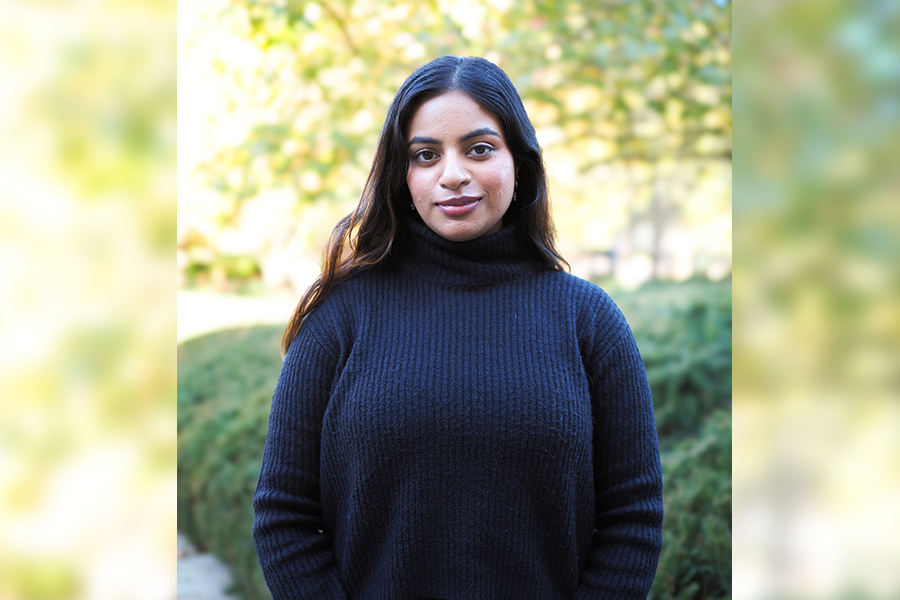
Meet Varnika
Nethmi started her Doctor of Physiotherapy in 2023. Prior to this, she completed a Bachelor of Science at Monash University, and an Honours year at the Monash Medical Research Centre. She was born in India and moved to Melbourne, Australia at a very young age, completing her schooling in the Western suburbs of Victoria.
-
At the start of my VCE, I was set on attending the University of Melbourne for a Bachelor of Science or Biomedicine after a visit to the Harry Brookes Museum of Anatomy and Pathology during Open Day. However, as I had decided to not study Maths Methods, I didn’t meet the maths prerequisite for them… but I continued to be drawn to the University of Melbourne! When I was looking at postgraduate options to study physiotherapy, naturally I found myself considering the University of Melbourne’s Doctor of Physiotherapy (DPT).
There were various reasons as to why this was the case: a strong one being location. The University of Melbourne’s Parkville campus was only a short commute from home and conveniently located close to the Melbourne CBD, allowing easy access to many wonderful cafes, shops and parks.
Additionally, UniMelb’s DPT program is consistently ranked very highly across all of the physiotherapy programs offered in Australia. It is well-organised with clear outcomes and areas of focus for each of the three years. DPT students can masters the many different elements and responsibilities that come with being a healthcare practitioner.
The University of Melbourne also has strong connections with many of Victoria’s largest public hospitals. As someone who was extremely interested in working as a hospital physiotherapist, I was very excited by the prospect of completing placements at such institutions.
Another point of interest for me was the DPT’s strong focus on research. While I could never see myself working as a full-time researcher, my honours degree taught me that I actually enjoyed many elements of research. Therefore, it was really rewarding to have the opportunity to work on a research project as part of my final year alongside clinical work.
-
While many aspects of the Doctor of Physiotherapy have been extremely challenging, they have also been equally rewarding. For me, clinical placement is one such highlight.
Clinical placement offers the opportunity to interact with and observe patients from diverse backgrounds, before gradually taking on the complex responsibility of assessing and treating them. Being able to do this in a well-scaffolded environment with lots of support from academics and supervisors has been crucial to helping me develop the confidence required to become an independent practitioner.
Another aspect of the DPT that I really appreciate is the fact that the bulk of our placements are in second year, rather than at the end of our three-year degree. Coming back to classes in third year has allowed me to learn advanced techniques and really build on the new skills I gained during placement. Lectures and online content are delivered prior to practical classes, and this format has been incredibly useful for consolidating my learning.
Finally, it has been incredible to connect with so many like-minded people in the DPT cohort! I know I will preserve and cherish many of these friendships for life. I have made so many wonderful memories on campus.
-
I would like to start out by working at a general musculoskeletal clinic before choosing a specialisation. Currently, I’m weighing between paediatrics, women’s health or advanced musculoskeletal practice.
I also aspire to work in research and education sometime in the future. As part of our final year, we are required to work on a capstone research project. My project focuses on mental health education for physiotherapy students. I have really enjoyed working on it and would absolutely love to continue working on similar projects.
-
Do you research! There are many things about the physiotherapy profession that I wished I had exposure to before I started my studies. For example, there are many common misconceptions about healthcare professions, and you may find that a profession is completely different to your initial assumptions. Thoroughly researching your chosen profession (shadowing if you can) will help you decide if it is right for you. Additionally, make use of every opportunity to ask students/professionals questions, whether this means attending Open Days, online information sessions or submitting enquiries.