Faculty of Medicine, Dentistry and Health Sciences celebrates the impact of its partnerships in India
The Faculty of Medicine, Dentistry and Health Sciences (MDHS) welcomed dignitaries from across India to celebrate its 150-year anniversary and the impact of its enduring health partnerships in the region at the Melbourne Global Centre – Delhi.
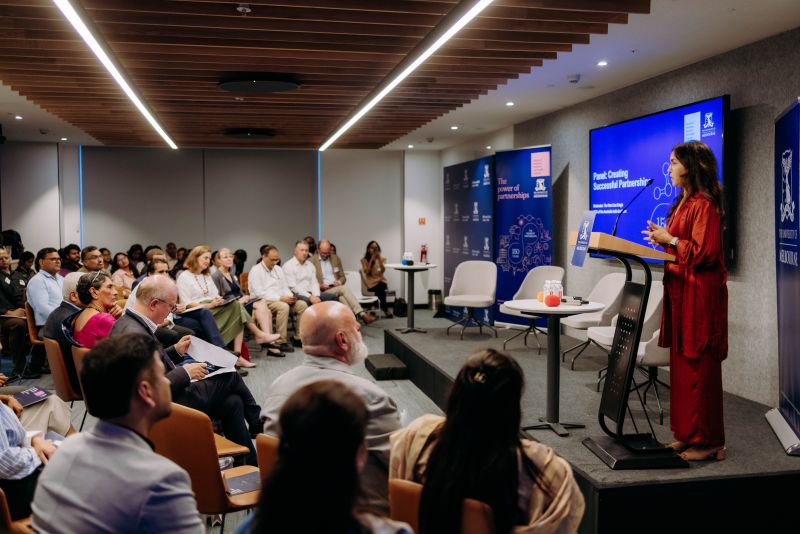
The Hon Lisa Singh, Director of the Australia-India Institute, addresses the audience at the celebration.
The event formed part of a larger faculty delegation that visited Delhi, Bengaluru and Vellore to meet with key partners and to reflect on the faculty's legacy whilst exploring future opportunities in global health, technology and innovation.
“India’s leadership in health, medical research, digital innovation, and healthcare delivery presents exciting opportunities for collaboration,” said Professor Nathan Grills, Academic Director India in the Faculty of Medicine, Dentistry and Health Sciences at the University of Melbourne.
“Having this opportunity to bring our partners together has been important not only to celebrate what we have achieved, but to forge new ways of working together to address health challenges and shape the future of global health.”
The faculty’s work in the region has been influenced by generations of university graduates who travelled and worked in India, most notably Dr Sister Mary Glowrey who travelled there in 1920 and founded the Catholic Health Association of India.
The faculty’s more recent formal partnerships span decades and include joint initiatives with the Public Health Foundation of India, the Christian Medical College (CMC) Vellore and other top institutions in the country.
These partnerships have focused on addressing challenges spanning HIV prevention, mental health, disability inclusion, non-communicable disease and infectious disease through knowledge exchange and mutual capacity-building programs that draw on expertise from both countries.
The faculty’s partnership with CMC Vellore has enabled student placements, visiting fellows, and collaborative research. A jointly supervised PhD program with CMC Vellore currently has 13 of their graduate researchers enrolled across nine departments and four schools at MDHS.
One of the faculty’s longest running Indian partnerships is with the Public Health Foundation of India, which in addition to joint appointments and research collaborations has a Master of Public Health student exchange scheme with the University of Melbourne.
More recently, the Melbourne India Postgraduate Academy was established to enable joint supervision of two PhD candidates each year with five top Indian universities – the IIT Kanpur, IIT Madras, IIT Kharagpur, IISc Bangalore and IISER Tirupati.
“These partnerships are embedding global perspectives in our education, research and engagement and enabling us to work together to make a real impact,” said Professor Grills.
“This celebration reaffirmed the faculty’s commitment to deepening partnerships with India, identifying new research collaborations and expanding global learning opportunities for students and researchers.”
At other stops on the visit, the delegation met with Australian and Indian government officials, including the Indian Council of Medical Research, and visited important non-government institutes including Sangath, the Azim Premji Foundation and CBM India.
The delegation also had productive meetings with leading universities including CMC Vellore, the Indian Institute of Science Bangalore, St John's Medical College and the National Institute of Mental Health and Neurosciences.
You can read a report detailing the faculty's health partnerships in India on the Australia India Institute website.