Building pipelines for Px4 Health

Px4 Health is an ambitious, world-leading initiative that will enable Australian research into personalised medicine at scale. It’s being developed right here in the Parkville Precinct and consists of three integrated platforms: the Px4 Phenotyping Platform, a biosampling, phenotyping and general health data measurement facility; the Px4 Multi-Omics Platform, which will provide comprehensive proteomic, metabolomics and lipidomic data for large scale clinical cohorts; and the Px4 Data Commons, a national data platform for sharing clinically accredited multi‑omics datasets.
So far, Px4 Health has secured $32.5 million in funding and in-kind support from the Australian Government and other partners: the University of Melbourne; the Murdoch Children's Research Institute (including the Biobanking Facility); the Bio21 Institute; Bioplatforms Australia; the Peter MacCallum Cancer Centre; and the Doherty Institute. When operational, Px4 Health will provide researchers with a unique opportunity to understand the complex interplay of factors – from environment and lifestyle factors down to our molecular biology – that impact our mental and physical well-being.
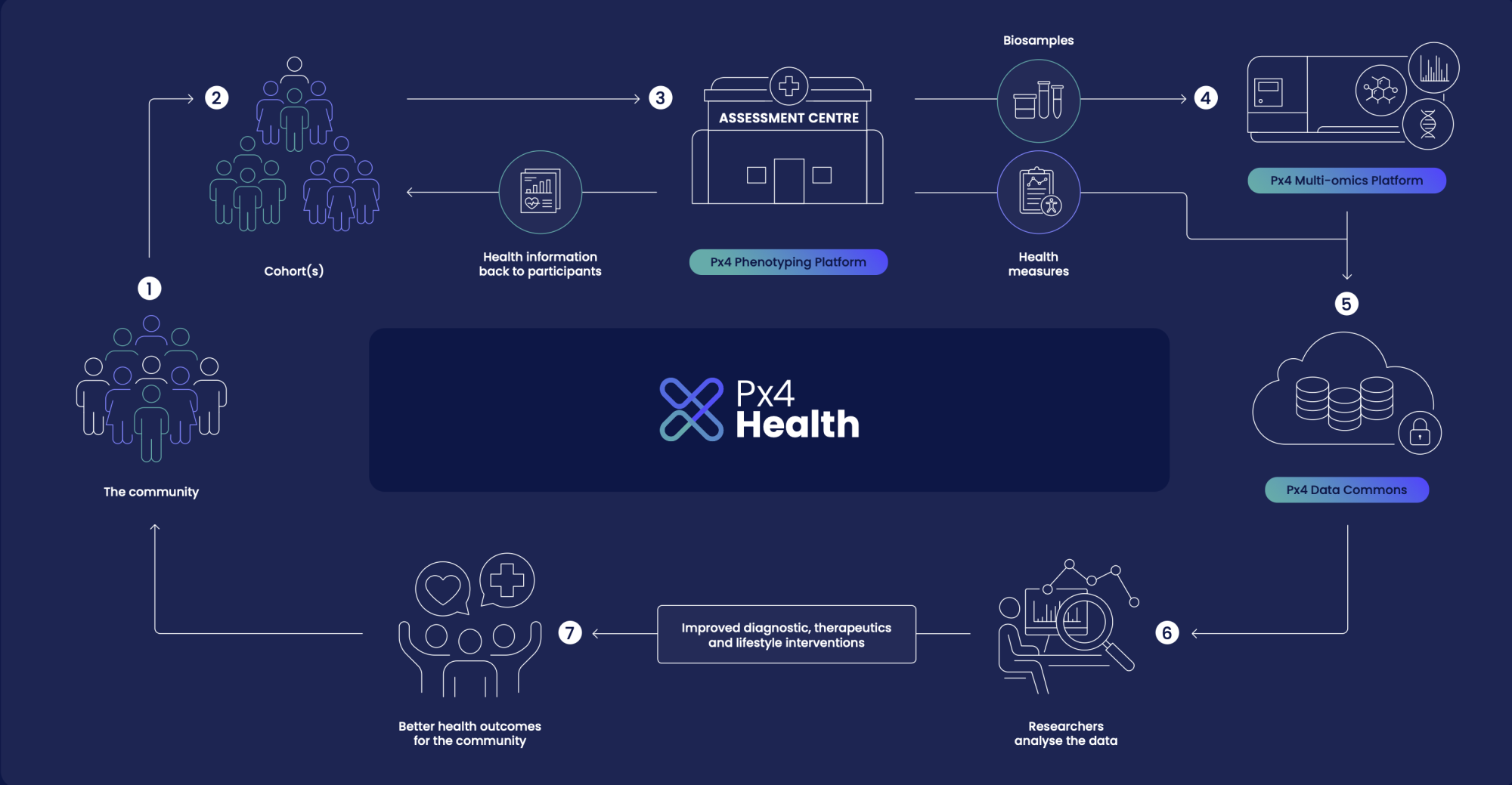
The Px4 Multi-Omics Platform will be critical to Px4 Health's ability to further research into precision personalised medicine by providing automated, high throughput, quantitative analysis of proteins, metabolites and lipids in a wide variety of clinical samples. Melbourne Bioinformatics is contributing to this capability as part of a subscription collaboration with PI Prof Olivia Carter (Melbourne School of Psychological Sciences). Our Bioinformatics Lead, Prof Bernie Pope, is a CI, and two of our bioinformaticians, Gayle Philip and Vini Salazar, have been devoting substantial time fractions to the project, focusing on two important workflows: whole genome sequencing (WGS) and metagenomics. These are interesting bioinformatics problems in themselves, but given the integrated, comprehensive nature of Px4 Health, solving them requires keeping the bigger picture in view.
For example, alongside technical questions such as the choice of analysis pipelines and variant annotation, Gayle is also highly conscious of the ethical requirements involved in her work. She points out that ‘Ensuring that data privacy and security is in line with what participants have consented to is a key part of the project’. Since data needs to be shared with other components of Px4 Health across a variety of domains, and potentially retained for a long period of time, the ethical use of this data therefore needs to be built into all parts of Px4 Health from the outset, which is being done according to FAIR principles. In addition, the need for interoperability and shareability of data and results requires clear and concise documentation of all processes, and the Px4 Multi-Omics Platform is working towards ISO 9001 accreditation by the end of 2027.
Vini also notes some of the unique challenges involved in designing metagenomics workflows. In contrast to WGS, which involves sequencing the genome of a single organism – the human patient being studied – metagenomics requires the parallel sequencing of the many bacterial species living in a particular microbiome. This is extremely useful, but the protocols and techniques involved are less well-established than with WGS, making the maintenance of in-house pipelines impractical. Vini is working on a combined methodological framework for the metagenomic analysis of Px4 faecal, saliva and plaque samples, based on Nextflow pipelines developed by the nf-core community. Finding that Px4 needs additional capabilities beyond those already available, he has taken a leadership role in the development of nf-core's funcprofiler pipeline, which enables the read-based functional profiling of microbiome sequencing data. ‘By adopting nf-core, we leverage the knowledge and efforts of a global community of bioinformaticians’, says Vini. ‘This enables us to stay current with best practices and ensures transparency and reproducibility.’
Px4 Health will be a flagship facility for the University of Melbourne and the Parkville Precinct, providing exciting new phenotyping, multi-omics and data sharing capabilities which will drive research into precision medicine in new directions. By making its deep bioinformatics expertise available through a subscription collaboration, Melbourne Bioinformatics is helping to ensure that Px4 Health will be a powerful asset for the Australian research community for many years to come.