Since its establishment in 2022, Melbourne Climate Futures (MCF) has spearheaded University of Melbourne’s initiatives in nurturing and empowering the next generation of climate researchers and leaders to tackle and resolve the problems besetting countries – at home and across the world – as a result of climate change.
This includes connecting with neighbouring countries in the Indo-Pacific to share ideas and collaborate on real action to ensure a sustainable, safe, fair and equitable climate future in the face of the monumental threat to health posed by climate change.
With health being one of its key policy priorities, MCF is convening the Indo-Pacific Climate Hub to accelerate development of a transformative resistance to climate change in health sectors in the region and to power the impetus for a sustainable future.
Taking collaborative action to advance transformative change in health and healthcare
The World Health Organization’s nomination of climate change as the single biggest threat to health and healthcare systems has accelerated the University of Melbourne’s research into climate change and human health for positive impact.
This impetus has also propelled the University to establish a partnership with the Kiribati Ministry for Health and Medical Services. The collaboration equips policy makers, health professionals and experts from both organisations with practical knowledge to boost development of healthy and equitable policies and programs to improve climate resilience.
A key platform of the partnership is the Climate CATCH Lab, a joint initiative of the University of Melbourne’s School of Population and Global Health and Melbourne Medical School within the Faculty of Medicine, Dentistry and Health Sciences, and the University-wide Melbourne Climate Futures. This initiative accelerates action towards climate-resilient, sustainable and equitable communities and health systems through research, engagement and education for enhanced impact.
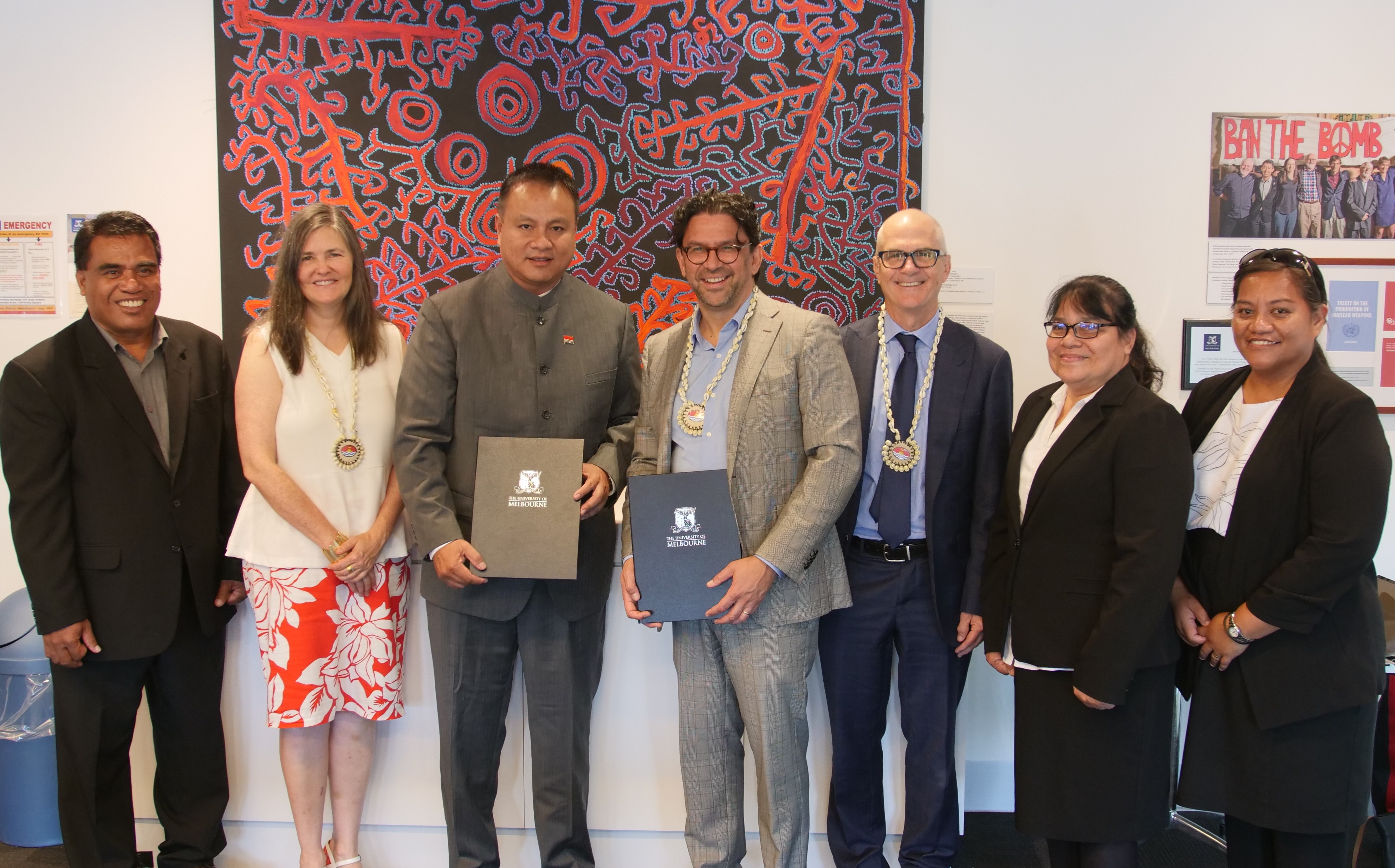
MoU signing with HM Tinte, Ministry for Health and Medical Services, Republic of Kiribati
Promoting employment pathways in Kiribati for people with disability
Since 2018, the University of Melbourne’s Nossal Institute for Global Health has been supporting people with disabilities in Kiribati in gaining access to vocational training and skills development to strengthen employment pathways.
Joining the Kiribati Ministry of Employment and Human Resource, the Australian Department of Foreign Affairs and Trade, and Scope Global in the Skills for Employment Program (SfEP), researchers within the Nossal Institute provide technical advice to support disability inclusion in Kiribati. The partner organisations are working in Kiribati with disability rights fund Te Toa Matoa, the Kiribati Deaf Association, and the Kiribati School and Centre for Children with Special Needs to develop and implement a disability support plan to improve access for people with disability.
Raising disability awareness amongst staff, students and partners, IT classes are delivered for people with vision impairment, construction classes for deaf students, and sign language training for staff and the general public.
Developing leadership potential to stimulate lasting change in the Indo-Pacific
In November 2023, the University of Melbourne and Pacific Climate Change Centre (PCCC) launched the Australia Awards Fellowship program, which invites emerging climate leaders from eleven Indo-Pacific countries, including Kiribati, to participate in an immersive six-week leadership, capacity development, knowledge exchange, and networking program.
Melbourne Climate Futures and the Melbourne School of Population and Global Health, in partnership with PCCC, co-hosted the fellowship program, which was funded by the Department of Foreign Affairs and Trade.
After completing formal training on a range of climate, health, equity, advocacy, policy and research strategies, Fellows co-designed and developed climate and health policies relevant to their local context with the support of a University of Melbourne mentor.
The Fellows will join a hybrid follow-up workshop in March 2024, hosted by the PCCC in Samoa, to discuss how the implementation of policies better outcomes for populations in their respective countries.