New International Research Laboratory will tackle treatment-resistant cancer
The University of Melbourne and France's National Centre for Scientific Research (CNRS) will establish a new International Research Laboratory in Melbourne that expands and consolidates the existing collaboration between the cancer laboratory of Professor Frédéric Hollande, from the University of Melbourne, and that of Dr Patrick Mehlen (CNRS, Lyon).
A Letter of Intent was signed 7 November 2024 at the Victorian Comprehensive Cancer Centre by Professor Mark Cassidy, University of Melbourne Deputy Vice-Chancellor (Research) and Professor Antoine Petit, Chairman and CEO of CNRS.
This new CNRS International Research Laboratory, funded by CNRS and the University of Melbourne, cements a long-term partnership, building on an existing collaboration.
The joint laboratory will use state-of-the-art technological approaches to study how single cancer cells change over time in the body’s tissues to understand what is causing cancer cells to form and to adapt to their environment. It will be named ‘PHANTOM’ (Plasticity, Heterogeneity and Tumour Microenvironment).
Led by Professor Hollande and located at the Victorian Comprehensive Cancer Centre (VCCC), the joint laboratory will accelerate research discoveries and enable clinical trials across the two countries.
This new lab builds on the University of Melbourne's partnership with the Centre National de la Recherche Scientifique (CNRS) in France through the Melbourne-CNRS Network (MCN) established in 2020.
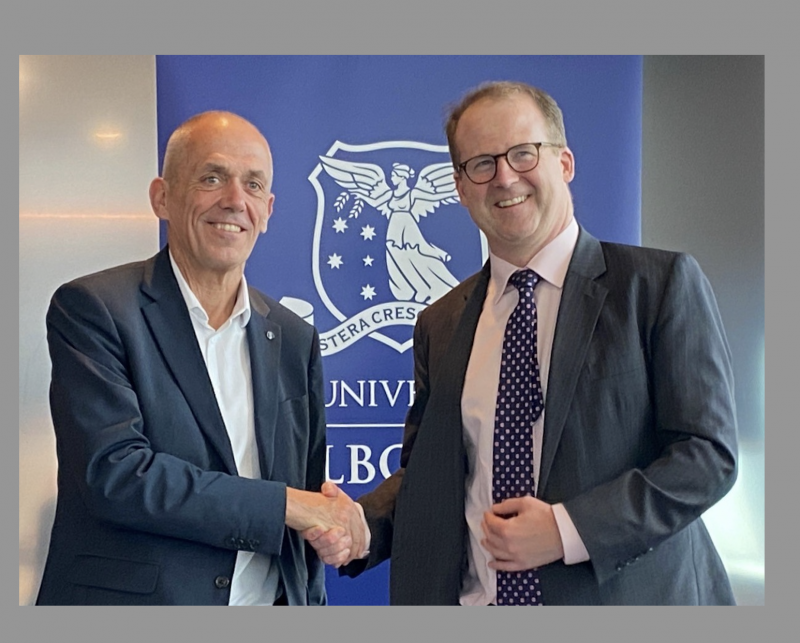
Professor Antoine Petit, CEO of the CNRS (left) and Professor Mark Cassidy, Deputy Vice-Chancellor (Research) at the University of Melbourne. Picture: Angie Plummer
The collective brings world-leading researchers together with PhD candidates from the University of Melbourne, CNRS, and French university partners to share knowledge and resources and deliver high-quality research outcomes.
Candidates enrolled within the Melbourne-CNRS Network complete their PhDs under joint supervision at the University of Melbourne and their choice of French partner university, in line with the project they will be examining. In addition to the scholarships on offer, selected candidates benefit from mentorship and peer support, as well as professional development and international networking opportunities that include the chance to present their work at the biennial MCN Symposium.
Building on international reputation
Prior to the establishment of MCN, the University of Melbourne signed a number of significant international research project agreements (IRPs) with CNRS, including with the French-based Cancer Research Centre of Lyon and the Institute for Advanced Biosciences at the Université Grenoble Alpes.
The new International Research Lab letter of intent signed on the 7 November 2024, is the latest development in the relationship, that strengthens connections and increases the opportunities for research collaborations with France.
Professor Frederic Hollande, lead researcher of the Dependence Receptors in Colorectal Tumours IRP (DeRECT IRP), now newly named PHANTOM laboratory is academic lead of the Melbourne CNRS Network. In Melbourne, Professor Hollande works out of the Melbourne Medical School’s Department of Clinical Pathology and at the University of Melbourne’s Centre for Cancer Research at the Victorian Comprehensive Cancer Centre. The agreement with the ApicolLipid was forged in association with the University of Melbourne by Professor Geoff McFadden from the University’s School of Biosciences.
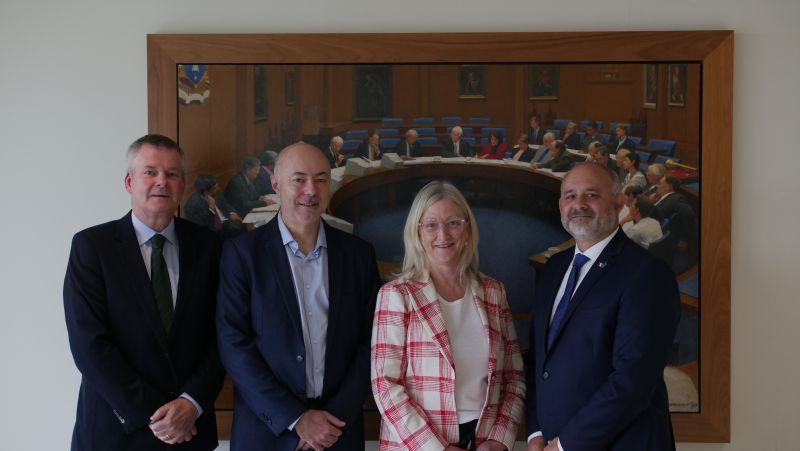
From left to right: Prof Mark Hargreaves AM, Pro Vice-Chancellor (Research Collaboration); Prof Frédéric Hollande, Vice-President of The Australian-French Association for Research and Innovation (AFRAN) & Head, Dept of Clinical Pathology; Prof Jane Gunn AO, Dean, FMDHS; and, His Excellency Pierre-Andre Imbert, Ambassador of France to Australia.
Immediate uptake from talented PhD candidates
The work of the Centre National de la Recherche Scientifique and the Melbourne-CNRS Network is well recognised in international academic, medical and scientific organisations in Australia and across the world, thanks to the involvement of associations such as the Australian-French Association for Research and Innovation of which Professor Hollande is vice president.
This reputation was influential in attracting a large and talented number of applicants from the first round. Of the 30 applications initially received, six were supported, five supported in the second round from 23 expressions of interest, and five in the current round.
The PhD candidates selected are paired and allocated to teams. Each team of two receives supervision from internationally renowned researchers who, in addition to Professor Hollande, includes the University of Melbourne’s Chair of Anatomy and Neuroscience Professor Janet Keast from the Department of Anatomy and Physiology, and Structural Biologist Associate Professor Isabelle Rouiller from the Department of Biochemistry and Pharmacology.