The Cumming Connector supports bold research that challenges conventional thinking and has potential to lead to paradigm-shifting discoveries and transformative impact in priority health areas, including infectious diseases, immunology, the microbiome, and neuroscience.
This partnership, between the University of Calgary, University of Melbourne (including the Doherty Institute) and The Florey Institute of Neuroscience and Mental Health (The Florey) has been made possible through the generosity of Canadian-born Melbourne resident, Geoff Cumming and his wife Anna Cumming.
The program was launched in 2026 and builds on an existing strategic partnership between the Faculty of Medicine, Dentistry and Health Sciences at the University of Melbourne, and the Cumming School of Medicine at the University of Calgary. It is driven by the two universities’ shared interest in stroke, infectious diseases, the microbiome and its impact on many different areas of medicine, neuroscience and clinical trials.
The program has a number of components, including:
- Calgary-Melbourne Cumming Post-Doc Exchange Program
- Seed grants
- Researcher and scholarship sabbaticals
- Joint research
- Conferences
Calgary-Melbourne Cumming Post-Doc Exchange Program
This prestigious exchange program will support exceptional postdoctoral researchers to pursue ambitious, boundary-pushing projects in Melbourne and Calgary. The program is a chance for rising researchers from the University of Melbourne (including The Doherty), The Florey and the University of Calgary to spend one to two years in a host laboratory at the partner institution to pursue high impact research in existing areas of strength at these institutions. The program may be offered for shorter periods from three to 12 months (to continue ongoing work between departments), with arrangements discussed on an individual basis.
The priority areas of research under this program include:
Infection, Inflammation, and Immunity, for example:
- Microbiome research and microbial therapeutics
- Immuno-therapeutics for cancer and other diseases
- One Health and anti-microbial therapeutics
- Anti-microbial resistance
- Pandemic preparedness
Neuroscience and Brain Health, for example:
- Stroke
- Neurological disorders
- Neuro-inflammatory conditions
Individual researchers will have an exceptional international experience and chance to boost their academic career through a program that will further cement the collaborative relationship between two universities and provide new research collaborations, speaking and presenting opportunities. Post-docs will be provided with relocation costs and bespoke tailoring to ensure that the exchange program works for them and their family.
Key Dates
Applications open: 24 June 2026
Applications close: 11.59PM AEST (Melbourne time), 1 October 2026
Outcomes expected: December 2026
How to Apply
Applications are to submitted via the University of Melbourne SmartyGrants portal. To commence an application, you will be prompted to create a SmartyGrants account.
Supporting Documents
Contacts
- University of Melbourne, Faculty of Medicine, Dentistry & Health Sciences: mdhs-grants@unimelb.edu.au
- University of Calgary, Cumming School of Medicine: medgrant@ucalgary.ca
Melbourne-Calgary Collaborative Seed Funding
The Cumming Connector Program has now provided funding for five cross-institutional teams from the University of Melbourne, The Florey and the University of Calgary.
More than $175,000 AUD in collective grant funding was awarded to five projects:
- RAMP: Rapid Advancement of Mpox Point-of-care Diagnostics with Chief Investigators: Dr Shivani Pasricha (Doherty Institute) and Professor Dylan Pillai (University of Calgary)
- Guardians of the Gut: Microbiome Therapeutics for Decolonising AMR pathogens from the gut with Chief Investigators: Dr Glen Carter (Doherty Institute) and Professor Kathy McCoy (University of Calgary)
- A cross-jurisdictional electronic health record based observational cohort of Enterococcal bacteraemia, with chief investigators Professor Steven Tong (Doherty Institute) and Professor Ranjani Somayaji (University of Calgary)
- Dirty mice, clean results: a pre-clinical model for immunity to infection that better mimics human immune responses, with Chief Investigators Dr Maximillien Evrard (Doherty Institute) and Prof Kathy McCoy (University of Calgary)
- Synergising Human Organoid Platforms to Support Pandemic Therapeutic Research with Chief Investigators Dr Laura Cook (Doherty Institute) and Prof Simon Hirota (University of Calgary)
The Florey & Hotchkiss Brain Institute Collaboration Grant Scheme
The Florey, in partnership with the Hotchkiss Brain Institute at the University of Calgary, has launched a joint Pilot Collaboration Grant Scheme to strengthen international research links in neuroscience.
This initiative will fund two projects of up to $50,000 AUD each, supporting collaborative research over 12 months. The scheme is designed to spark new partnerships or expand existing collaborations between Florey and HBI researchers across all areas of brain science. Projects exploring the intersection of infection, the microbiome, and brain health are particularly encouraged.
Each project must include a Lead Investigator from both institutes, with funding shared equally between the two organisations. Applications are assessed on innovation, feasibility, collaborative contribution, and long-term partnership potential.
By fostering cross-institutional collaboration, this program aims to accelerate discovery and build sustainable global research networks addressing complex challenges in brain health.
Aus-Can Symposium
In October 2025 a joint event held in Melbourne showcased the partnership between the University of Melbourne, The Florey and the University of Calgary and associated institutes: the Snyder and Hotchkiss in Calgary, and in Melbourne - The Doherty.
The symposium - entitled Frontiers in Neuro-Microbial Interactions – explored infectious diseases, immunology, the microbiome, and neuroscience.
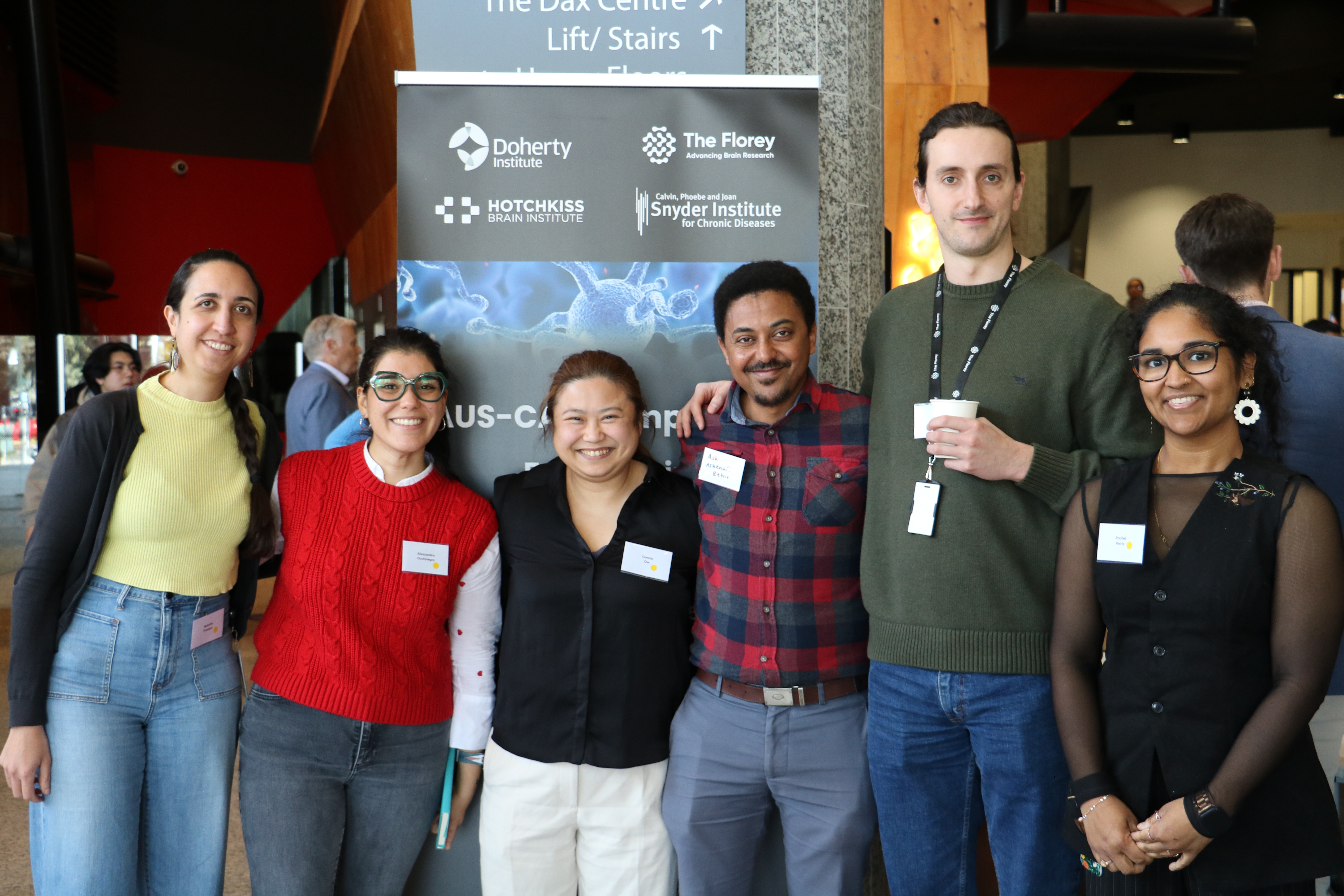
Aus-Can Symposium 2025
Stroke research
Stroke researchers from Melbourne are collaborating closely with colleagues at the University of Calgary, with structured engagement driving joint work. The partnership includes quarterly seminars to share research and identify new opportunities, as well as dedicated think tanks. The first was held in Helsinki in 2025, another will be held in Seoul in 2026.
Collaboration is already translating into joint activity. For example, Melbourne-based acute hospital intervention and statistical modelling teams are contributing to the ACT-GLOBAL stroke platform trial, and rehabilitation and statistical modelling teams are advising on new early phase trials in Calgary.
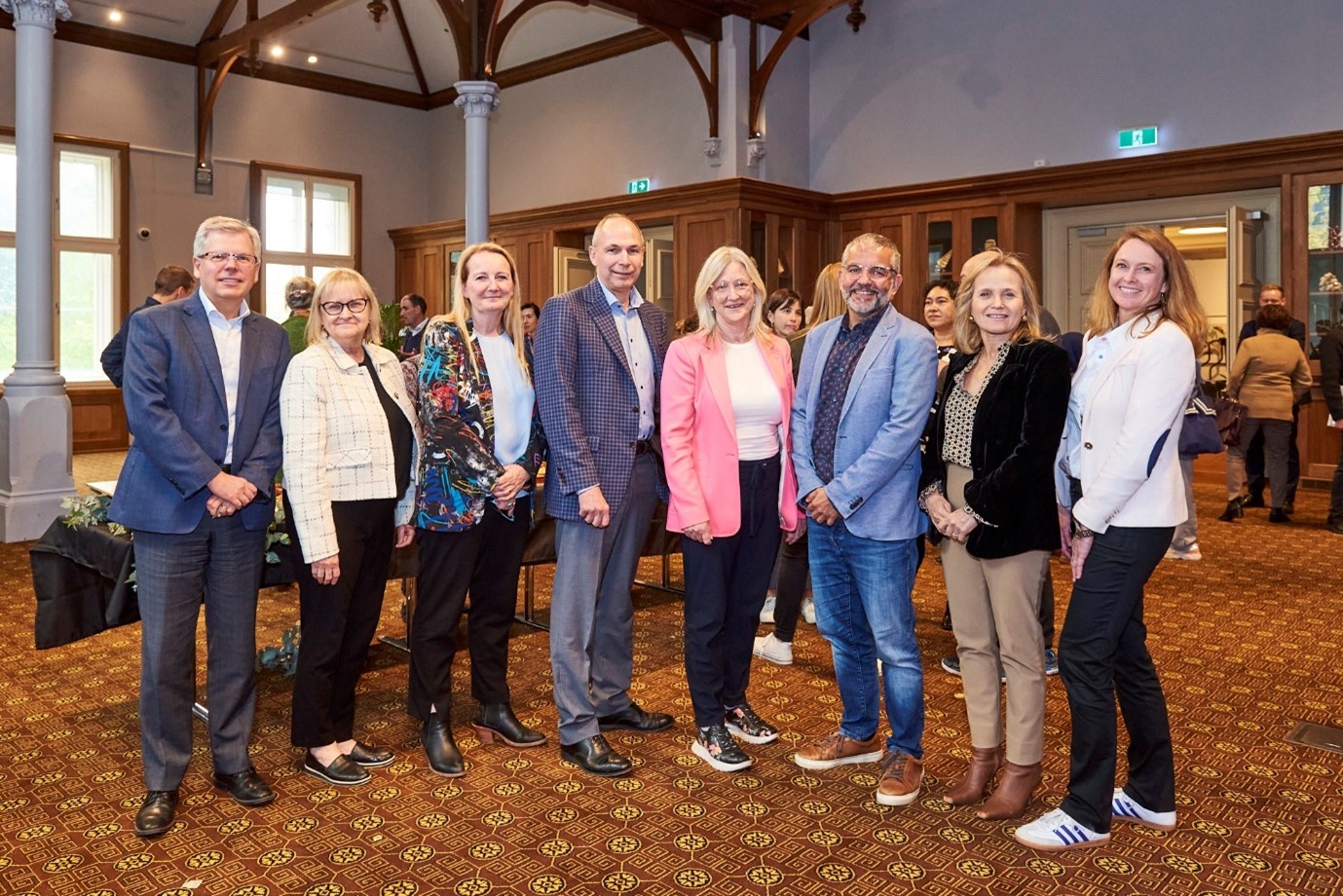
Calgary and Melbourne staff at Advancing Health 2030 Impact Panel Discussion 'Gut Reaction: Exploring the microbiome's affect on health', held at the University of Melbourne in 2024. (L-R) Professor Richard Leigh, Professor Beverly Adams, Professor Kathy McCoy, Professor Todd Anderson (Dean, Cumming School of Medicine), Professor Jane Gunn (Dean Faculty of Medicine, Dentistry and Health Sciences, currently Interim Provost), Professor Sammy Bedoui, Professor Sharon Lewin and Professor Elisa Hill-Yardin