
What is WECARE?
WECARE uses computer simulation and co-design to create a digital blueprint of hospital ward operations, identifying and eliminating administrative burden so staff can spend more time on patient care.

Understanding the real problem
We are conducting time and motion studies, interviews with staff and consumer focus groups to map exactly how hospital work actually happens. This reveals where time is wasted on low-value tasks, what drives job dissatisfaction, and what staff and patients really need. We are not guessing; we are measuring.

Building a digital model of the ward
We are creating a relational database and simulation model that mimics real-life hospital dynamics and staff interactions. This digital blueprint allows us to test different ways of working without disrupting actual patient care. We can stress-test the model against common pressures like staff illness or high patient loads to see what breaks and what holds.

Finding the best solution together
We are working with hospital staff, patients and leaders to rank the top three preferred models of working based on cost, impact and what people actually want. This is co-design, not top-down change. The solutions that emerge are grounded in real data and shaped by the people who will live with them.
Why this matters
Australia's hospitals are in crisis. Over 80 per cent of major health professional groups report skill gaps, and understaffing is worst in outer suburban, regional and rural hospitals where it jeopardises care quality and staff retention. The problem is not just too few staff; it is that the staff we have are overwhelmed by paperwork and low-value administrative tasks. We think nurses and allied health workers may spend hours on work that does not help patients, taking time from the care that matters. This may drive burnout, job dissatisfaction and the intention to leave, creating a vicious cycle where more staff leave, remaining staff are stretched thinner, and care quality suffers. Australia lacks a systematic, evidence-based approach to redesign hospital work and eliminate this burden. WECARE addresses this by using computational modelling and co-design to create better ways of working. By identifying and removing low-value tasks, we aim to free up time for direct patient care, boost staff satisfaction, improve retention and ultimately deliver higher-quality care. This is not about working harder; it is about working smarter.
What we're changing
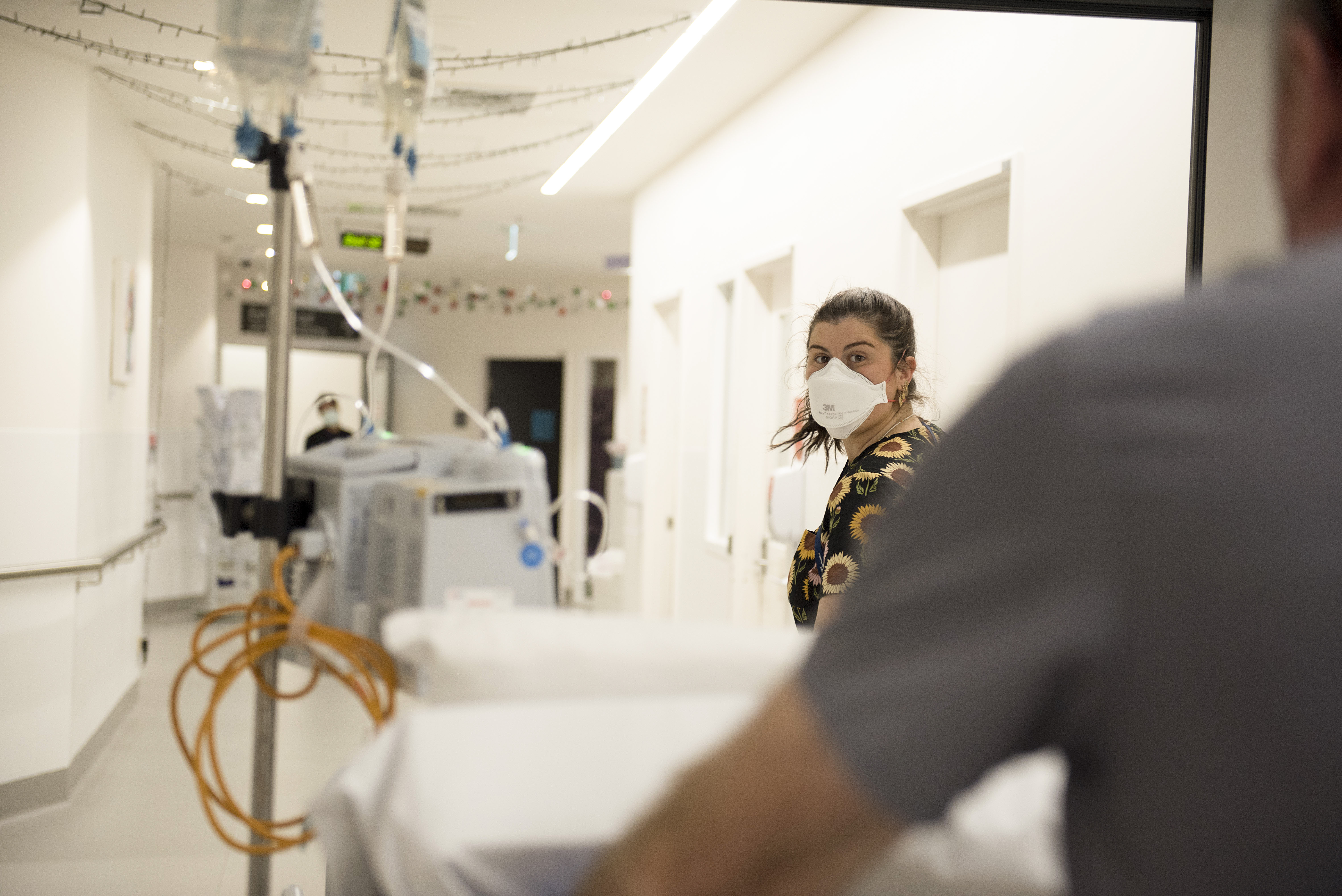
Australia faces a critical healthcare workforce shortage, with over 80 per cent of major health professional groups reporting skill gaps in 2023. WECARE is changing this by using computational modelling and implementation research to redesign hospital work. We are conducting time and motion studies and interviews with staff across general medicine wards in metropolitan and regional hospitals to identify exactly where time is wasted and whether AI or even robots could help with care. We are building a simulation model that mimics real ward dynamics, allowing us to test different models of working and stress-test them against common pressures. We are working with Western Health, Bendigo Health, the Victorian Department of Health, Safer Care Victoria and the Faculty of Engineering and Information Technology to co-design solutions with staff and patients. Success means identifying low-value tasks, agreeing on a model of working that improves staff satisfaction and frees up time for patient care, and scaling that model across Victorian hospitals and potentially nationally.
Our experts

Dr Fjalar de Haan
Dr Fjalar de Haan is a Senior Research Fellow with the Department of Psychiatry at the University of Melbourne. He holds an MSc in theoretical physics and a PhD in transition dynamics, and is a mathematical and computational modeller interested in the dynamics and transformations of complex systems. He has worked across health care, water, energy and agri-food sectors as part of international, interdisciplinary teams with industry and government. He leads WECARE's development of the relational database and simulation model that will create a digital blueprint of hospital ward operations.

Professor Harriet Hiscock
Professor Harriet Hiscock is a consultant paediatrician, Fellow of the Australian Academy of Health and Medical Sciences, and Academic Lead of the Transforming Healthcare Impact Domain at the University of Melbourne. Her research focuses on developing and implementing new approaches to reduce low-value care and improve health and wellbeing. She brings expertise in health services research, implementation science and translating evidence into practice change, and contributes to WECARE's research design, stakeholder engagement and translation strategy.
This project is funded by the HCF Research Foundation