The science of Learning Health Systems
 Dr Sathana DushyanthenFollow 15 min read · February 2, 2026
In this microlearning, you will:
- Explain how Learning Health Systems differ from traditional quality improvement methods.
- Have awareness of the steps involved in the Learning Health Systems framework.
- Understand how the Learning Health Systems approach can help with continuous data-driven quality improvement.
If you enjoy this learning experience, please explore the Learn page to see our other education offerings.
Why Learning Health Systems, why now?
Healthcare faces rising complexity, constrained resources, workforce fatigue, and fragmented digital systems, making traditional one-off improvement projects increasingly unsustainable. Learning Health Systems (LHS) addresses this by embedding learning into routine care and reusing data, infrastructure, and feedback loops, shifting improvement from episodic projects to a reusable organisational capability that lowers the cost of learning and makes continuous improvement sustainable.[1]
But what is a Learning Health System?
Healthcare generates vast amounts of data every single day. 36% of the world’s data, to be precise, yet 97% goes unused.[2] Ultimately, the goal of healthcare is to improve patient outcomes and deliver high-quality, value-based care (The Quintuple Aim). So, just how do we use data to make healthcare better?
An LHS is one in which every patient encounter is an opportunity to learn and improve that patient’s care. For this to occur, the knowledge generation processes are embedded into daily clinical practice, in order to continually learn from incoming data and apply the insights gained to improve the quality, safety, and outcomes of healthcare delivery, in real time.
LHS is therefore a mindset shift (culture change), rather than just an activity that is undertaken. Digital transformation inherently lends itself to data-driven quality improvement using LHS. A Learning Health System is a deliberately adaptive system. A healthcare organisation learns from its data when it follows the cycle of data → knowledge → practice. It creates structured feedback loops between:
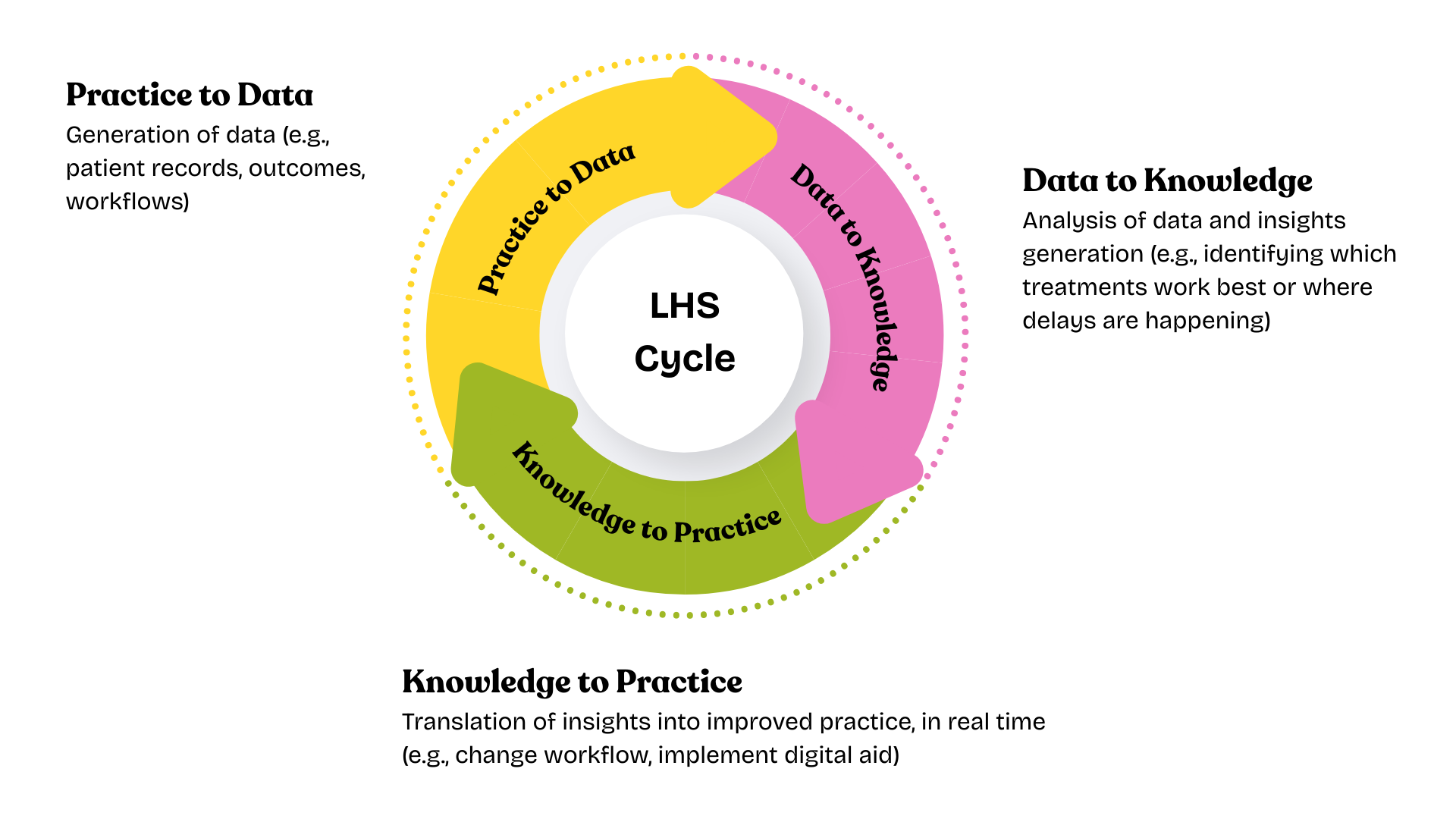
The key elements of a Learning Health System are:
- Data infrastructure: systems such as EMRs that capture high-quality data.
- Analytics capability: tools and people who can analyse that data and extract meaningful insights (learning that becomes system knowledge).
- Change management: the ability to put insights into action (e.g., updating clinical guidelines or workflows).
- Culture of collaboration (learning communities): clinicians, researchers, data, IT professionals, and patients all work together and value learning and improvement.
- Feedback loops: mechanisms to track whether changes made lead to adaptation and better outcomes. [3,4]
In summary, an LHS is a structured way to rapidly turn data into tangible improvements. LHS allows your team to get the data they need, understand what the data is telling them and then use it to make things better.
What makes LHS different?
In healthcare, we already use approaches such as quality improvement, audits, research, and plan-do-study-act (PDSA) cycles to improve care. So, it’s reasonable to ask - what makes an LHS different? The short answer is: an LHS doesn’t replace these approaches; it connects, scales, and sustains them using data and continuous learning.
Here are some comparisons[5] to help you distinguish the difference. Select the cycle icon for each approach:
Hypothetically speaking
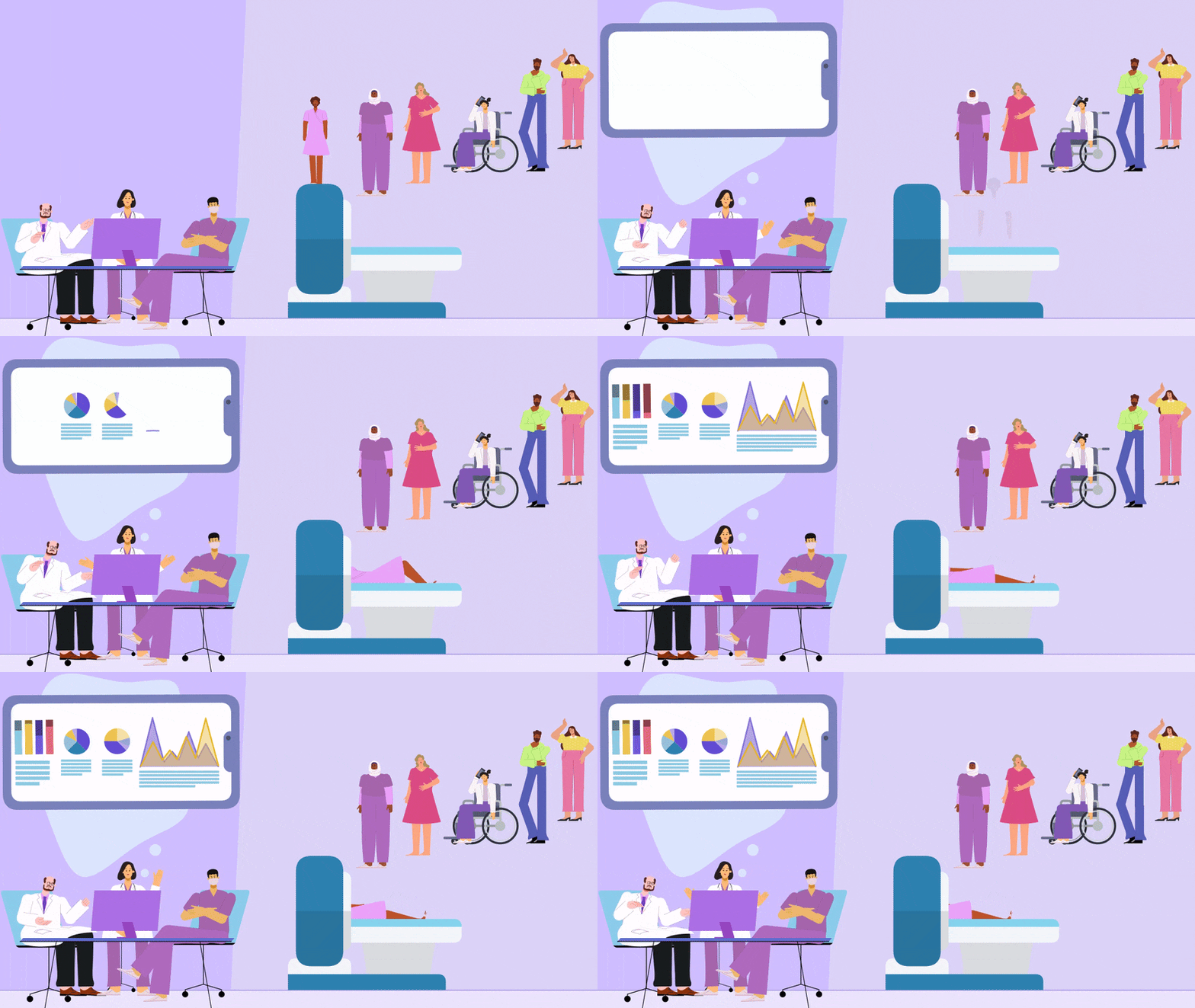
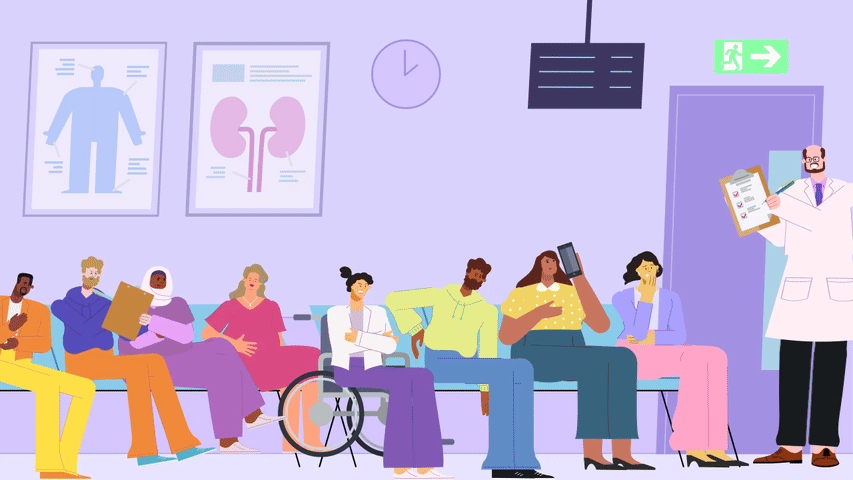
A metropolitan hospital notices a steady rise in emergency department (ED) presentations from patients with diabetes. Many visits relate to hypoglycaemia, poorly controlled blood glucose, medication confusion, and late presentations of preventable complications. Several of these patients have had 3-5 ED visits in a short period, despite being enrolled in chronic disease management plans.
The hospital wants to understand the problem and design a smarter, data-enabled solution and has assigned you to lead the quality improvement team.
Where do you start?
A spin around the cycle
Let's explore how navigating the LHS cycle can inform our understanding of the problem and enable us to design smarter, data-driven solutions.
Select the > arrows to move through each stage of the cycle and the i boxes to learn about what steps we can take to reach our solution.
Learning = Actionable insight + Implementation + Evaluation + Iteration
What have we learnt from our spin around the LHS cycle? With an LHS, you:
- Continuously detect patterns in ED presentations.
- Integrate data from primary care, hospital, community services, and digital tools.
- Test, refine, and scale interventions.
- Adapt in real time as the system changes.
Building a Learning Health System is everyone’s responsibility
A Learning Health System does not emerge from a single project, platform, or profession. It is built through coordinated action across clinical, data, technical, research, and leadership roles, aligned around a shared commitment to continuously learning from care and improving practice.
If you want to jumpstart an LHS vision in your context, the question is not “who leads this?” but rather, “what is my role in making learning routine?”
Below, we outline how different types of roles can contribute to addressing the barriers and facilitators of LHS establishment. Select each role to learn more.
Key takeaways
- Unlike audit, QI, research, or PDSA, which are typically episodic, local, and time-limited, a Learning Health System is a continuous, system-wide approach that embeds data-driven learning into everyday care.
- Learning health systems harness rapid, real-time, data-driven continuous improvement, through the cycles of data→ knowledge→ practice.
- Underpinning any learning health system is a mindset for improvement, innovation and transformation.
Want to dive deeper into data-driven quality improvement and explore how you can apply the learning health systems approach to your healthcare transformation? You are already an integral part of the system; what matters now is whether you help it learn. Learn how through our short course: Learning Health Systems.
References
[1] Learning health system strategies in the AI era
[2] What To Do About Healthcare’s 'Messy Desk' Data Dilemma
[4] A framework for understanding, designing, developing and evaluating learning health systems