A GP's path to data-driven quality improvement
"The courses helped me dive into areas I needed to improve and gave me practical tools I could apply straight away."
Dr Bianca Forrester
Learner in the Centre's Learning Health Systems and Transforming Healthcare with Data Analytics and AI short courses
|
Motivating question: How can we use clinical data to improve care?
Dr Bianca Forrester is a GP with 20 years’ experience and is currently a research lead for Learning Health Systems at Western Victoria Primary Health Network (WVPHN).
During COVID-19, she led a region-wide learning network to curate epidemiological data, public health information, support knowledge translation and co-develop practice change ideas. GP ‘champions’ and teams supporting the program recognised that the organisation was changing alongside GP practice, and that the process they used mirrored the Learning Health System cycle: identifying problems, accessing data, applying evidence, and translating insights into practice.
In 2023, she took the CDTH’s Learning Health Systems short course, starting her journey into data-driven quality improvement.
“I started recognising the Learning Health System as a model that would help us work faster and smarter, but also capture our achievements and successes... we had been operating through cyclical routines and recognised that we didn’t have to reinvent the wheel each week, if we adopted a systemised approach.”
“The cycles felt intuitive, but I still wanted to validate my approach and gain practical tools to help us accelerate our organisational learning cycles.”
User-centred design was a topic area that particularly sparked Bianca’s interest.
“It highlighted the importance of designing from a consumer and provider perspective, and showed how insights and data can be shared across the care continuum.”
She was so driven by the concept of Learning Health Systems that she pursued an industry-based PhD on a regional primary care-led model, creating a continuous evaluation framework.
A few years later, Bianca noticed that her understanding and use of AI moved from being almost zero to knowing that it is central to extending use of data and digital tools in primary care.
“The promises of digital health are there, and GPs hope AI can help us to improve our efficiency, and perhaps capture patient data for learning and improvement.”
She knew the next step was a structured approach to accurately collect routine data and these emerging tools to drive quality improvement.
Bianca’s experience doing the Transforming Healthcare with Data Analytics and AI course
With a demanding clinical schedule, Bianca needed a course that was flexible, online, and practical — something designed to fit around her work while offering interactive workshops and real-world application.
So, she enrolled in Transforming Healthcare with Data Analytics and AI. The short course goes for 12-weeks, with both self-paced online learning modules and live Zoom workshops.
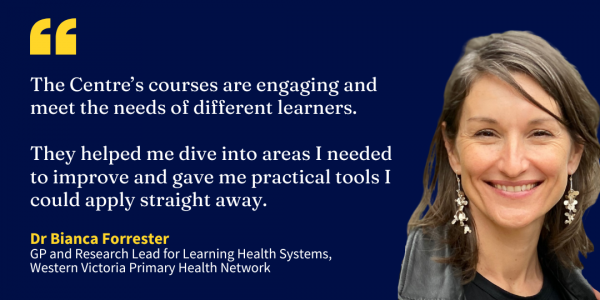
“The Centre’s courses are engaging and meet the needs of different learners. They helped me dive into areas I needed to improve and gave me practical tools I could apply straight away.”
For Bianca, a big drawcard was the fact that the course is facilitated by interprofessional specialists, data/AI experts and health tech industry leaders.
“The interactive elements helped us build lovely relationships between clinicians, informaticians, analysts, and systems engineers... It gave us the chance to learn each other’s language—a real challenge for clinicians when talking to data people—and to communicate effectively across these roles.”
An element that particularly resonated with Bianca was the course's focus on working with real healthcare data to collaboratively develop solutions with practical applications.
“We can't do everything ourselves; it requires teamwork and collaboration. We put that into practice through the course, and it created the energy for me to keep trying to do that in my work.”
How the course helped
One of the most valuable outcomes of the Transforming Healthcare with Data Analytics and AI course for Bianca was the chance to apply what she was learning in real-time, and develop skills to communicate across key roles involved in quality improvement.
The course deepened her skills in data mapping, data management and visualization development, and design thinking for users.
“The short courses make it easy to get a taste, learn different languages, and explore emerging theories as they evolve... A shared language and the right tools can help us span the distance as we move through the Learning Health System cycle—and that’s the key...”
Bianca now champions interdisciplinary teamwork and urges clinicians to start small, celebrate wins, and keep the momentum going.
“Take on small projects, find others who share your interest, and just keep learning together as you go.”
“A Learning health System is always learning, and the digital and AI environment is rapidly changing making it crucial to learn how to harness these assets.”
“Our ultimate aim is to improve care for consumers along a continuum, and to support health services to identify systems gaps and improve services delivery. Now, with health information technologies and advanced analytics, there is the potential to work in smarter, more informed ways, and use data for decision making in everything we do.”
Interested in going on a similar journey? Find out more about the Learning Health Systems and Transforming Healthcare with Data Analytics and AI short courses.