
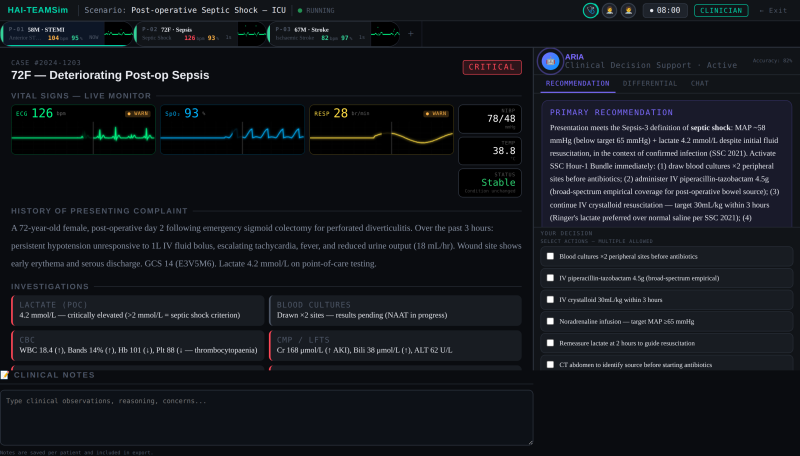
HAI-TEAMSim is a browser-based clinical simulation platform that lets researchers study how clinicians make decisions when working alongside AI across emergency, ICU, and neurology scenarios.
HAI-TEAMSim is a configurable research platform that puts human-AI teaming at the centre of clinical decision-making research. It presents clinicians with realistic acute care scenarios – including STEMI, septic shock, and acute ischaemic stroke – alongside ARIA, a configurable AI clinical decision support system.
Unlike static vignette-based tools, HAI-TEAMSim combines live physiological waveforms, dynamic patient deterioration, and five experimentally distinct AI conditions from no AI support through to AI that actively probes clinician reasoning. Researchers can manipulate cognitive load, team size, AI accuracy, and time pressure in real time.
HAI-TEAMSim supports experimental research on automation bias, AI reliance, clinical decision quality under cognitive load, and the effect of AI interaction style on human reasoning. It is equally suited to educational workshops that help clinicians reflect on how they respond to AI recommendations in practice.
How can HAI-TEAMSim support your work?
Investigating human-AI teaming in acute care
Use HAI-TEAMSim to run controlled experiments on automation bias, AI reliance, and the effect of AI interaction style on clinical decision quality. The platform's five AI conditions and configurable cognitive load parameters support a wide range of experimental designs. All data is captured automatically in a FHIR-aligned research database.
Running workshops that show clinicians how they respond to AI
Clinical educators and simulation coordinators can deliver simulation workshops, enabling clinicians to work through realistic acute cases alongside AI support and debrief using their own decision data. HAI-TEAMSim provides an evidence-based, engaging format for CPD on human-AI teaming in clinical practice.
Testing how clinicians engage with your AI in a safe environment
Health technology companies and AI developers can use HAI-TEAMSim to evaluate clinician responses to AI decision support before clinical deployment. The platform's configurable AI conditions and FHIR-aligned data pipeline make it well-suited to pre-deployment human factors evaluation and regulatory evidence generation.
Embedding AI readiness training into your simulation program
Hospital simulation departments, educators, and clinical leads can integrate HAI-TEAMSim into existing simulation curriculum to prepare clinical staff for working with AI decision support tools. The platform requires no installation and runs in any modern browser, which makes it deployable in simulation centres, ward training rooms, or remotely.
Features and scenarios
| Five AI Conditions | ARIA – Clinical Decision Support System | Live Clinical Scenarios | Researcher Control Panel | FHIR-Aligned Data Backend |
|---|---|---|---|---|
| A fully configurable AI interaction model: No AI, AI Recommends, AI Summarises, AI Probes (Accurate), and AI Probes (Inaccurate). Each condition presents a distinct human-AI interaction paradigm, enabling between-subjects or within-subjects experimental designs. | ARIA (Adaptive Reasoning Intelligence for Clinical Assessment) is the platform's AI layer. It presents guideline-grounded recommendations, case summaries, and post-decision Socratic probes – all configurable by the researcher without any machine learning dependency. | Three high-fidelity acute care scenarios: Anterior STEMI (ED), Post-operative Septic Shock (ICU), and Acute Ischaemic Stroke (Neurology), each with live physiological waveforms, dynamic patient deterioration, evidence-based clinical options, and FHIR-aligned data capture. | A real-time researcher dashboard for configuring and monitoring experimental sessions. Controls include AI condition, time pressure, patient load, team size, AI accuracy display, and all visibility toggles. Session data is locked on scenario start to protect experimental integrity. | All session data including decisions, confidence ratings, clinical notes, probe responses, and NASA-TLX scores are written in real time to a FHIR R4-aligned PostgreSQL database hosted in Australia. FHIR Bundle export is available for integration with clinical systems. |
How to get started →
Whether you're coming with a fully formed project or just an early idea, we'll work with you to find the right approach.
-
Contact Dr Sonia Jawaid Shaikh to discuss your research question, educational objective, or evaluation need. We will identify the right scenario, AI condition, and data collection approach for your context.
-
For research involving human participants, ethics approval is required through your institution's HREC. The platform team can provide a data management plan, FHIR schema documentation, and participant information templates.
-
Work with the platform team to configure your experimental conditions such as AI involvement in clinical work, clinical and human-AI teaming scenarios, cognitive load parameters, and visibility settings. A pilot session is recommended before full data collection.
-
Run sessions at your institution or remotely. All data flows automatically to the FHIR-aligned Supabase database hosted in Australia. Post-session exports are available as CSV or FHIR Bundle JSON.
FAQs
-
HAI-TEAMSim (Human-AI Teaming Simulation) is a browser-based clinical simulation platform developed at the University of Melbourne. It presents clinicians with high-fidelity acute care scenarios alongside ARIA, a configurable AI clinical decision support system, and various team-based factors which enable researchers and educators to study and teach human-AI teaming in healthcare.
-
HAI-TEAMSim is purpose-built for human-AI teaming research. Unlike general clinical simulation tools, it offers five experimentally distinct AI interaction conditions, real-time researcher control of cognitive load parameters, and automated FHIR-aligned data capture which makes it uniquely suited to rigorous experimental and educational work on clinician-AI interaction.
-
The platform is available to University of Melbourne researchers, external academic collaborators, clinical educators, hospital simulation departments, and industry partners. Research use involving human participants requires institutional ethics approval. Educational and evaluation use can be arranged directly with the platform team.
-
Key features include: five configurable AI conditions; three high-fidelity clinical scenarios with live waveforms and dynamic patient deterioration; a real-time researcher control panel; FHIR R4-aligned data capture; NASA-TLX cognitive load assessment; and FHIR Bundle JSON export for health system integration.
-
A typical research engagement involves an initial scoping conversation, ethics approval (if applicable), scenario and condition configuration, a pilot session, full data collection, and data export. Educational workshops typically run as sessions with a debrief phase using participant decision data. The platform team supports all stages.
-
Research involving human participants requires ethics approval from your institution's Human Research Ethics Committee (HREC). The platform team can provide supporting documentation including a data management plan, FHIR schema reference, and participant information templates. Purely educational use without data collection does not require ethics approval.
-
HAI-TEAMSim runs entirely in a standard web browser and no installation, no special hardware is required. It is accessible on any device with a modern browser and internet connection. The platform is screen-reader compatible and keyboard-navigable. Contact the platform team if you have specific accessibility requirements.
-
Contact Dr Sonia Jawaid Shaikh at the University of Melbourne to discuss your project or arrange a demonstration.