University of Melbourne researchers demonstrate lifesaving impact of telehealth stroke care
An international team of stroke specialists, led by University of Melbourne researchers, have demonstrated that telehealth specialist care delivered through Australia’s first Mobile Stroke Unit (MSU) is as effective as in person care, enabling faster, lifesaving treatment for patients.
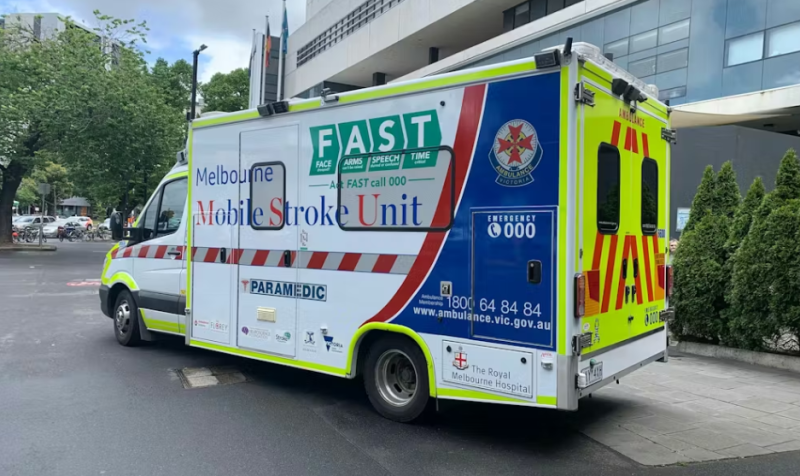
Source: The Royal Melbourne Hospital. The Mobile Stroke Unit (MSU) is a purpose-built ambulance that contains an on-board CT scanner and specialist stroke team.
The research paper, co-authored by the University of Melbourne’s Professor Geoffrey Donnan AO and Professor Stephen Davis AO, co-chairs of the Australian Stroke Alliance, was published in the New England Journal of Medicine - Evidence.
The study confirmed that a neurologist operating remotely via telehealth can safely and accurately direct assessment and treatment on the MSU, removing the need for an onboard neurologist and enabling efficient delivery of urgent stroke care outside the hospital setting.
The MSU is a specialised Melbourne ambulance with a CT scanner and a dedicated stroke team, including paramedics, a stroke nurse and a radiographer, who assess and treat suspected stroke patients before they reach hospital.
The initiative is led by the Royal Melbourne Hospital (RMH) in collaboration with the University of Melbourne, Ambulance Victoria, The Florey, the Australian Stroke Alliance, Stroke Foundation, and the Victorian State Government.
In the world’s first controlled study, conducted with international partners including the Ottawa Hospital Research Institute, the team directly compared onboard neurologist care with remote telemedicine care, for prehospital stroke patients.
Across 168 operational days, the team assessed 275 suspected stroke cases, generating some of the strongest evidence yet for expanding telemedicine-supported critical care.
Telehealth neurologists were able to devote 100 per cent of their allocated MSU time directly to patient care, compared with just 33 per cent for onboard neurologists.
The University of Melbourne’s Professor Geoffrey Donnan said the study was proving the benefits of telehealth for stroke treatment.
“This research provides some of the clearest evidence yet that advanced telehealth can reliably and efficiently support complex decision-making in the field,” Professor Donnan said.
“The consistency of results across hundreds of real-world cases demonstrates just how effective this model is, and that it is ready for wider adoption.”
Director of the Melbourne Brain Centre at the RMH, Professor Stephen Davis, said the findings would help streamline care and provide positive patient outcomes.
“Telemedicine allows us to utilise state-of-the-art technology to deliver world-class stroke expertise wherever the patient is - not just where a neurologist happens to be,” Professor Davis said.
“With the first hour after stroke symptoms onset being known as the ‘golden hour’ due to how critical intervention is, this gives us the best chance of reversing damage and saving lives.”
Australia’s first MSU began operating in 2017, providing rapid stroke assessment and treatment within a 20 minute radius of Melbourne’s CBD. A second unit started working in Melbourne’s southeast in 2024.
Today, more than 30 MSU programs are active or emerging around the world, spanning Europe, North America, South America and Asia.