Portable diagnostics innovation to advance newborn and maternal health in Malawi
A team of students and researchers recently met in Malawi to refine and road-test a new approach to diagnose active syphilis infections, as part of a new collaborative venture between the Kamuzu University of Health Sciences and the University of Melbourne.
Supported by the MDHS Innovation Fund, the project aims to reduce maternal and neonatal mortality in Malawi by applying the principles of social entrepreneurship to deliver an affordable and locally integrated point-of-care diagnostic test for active syphilis.
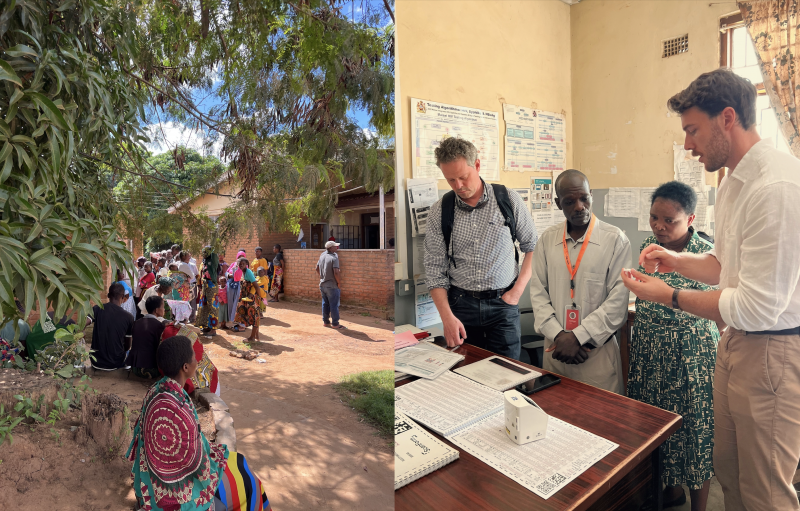
A rural health centre in Malawi delivering essential antenatal care including syphilis, HIV and viral hepatitis screening for pregnant women (left image). Inside the healthcare centre, Dr Jack Richards and Dr George Taiaroa are shown describing the new portable diagnostics tool currently in development (right image).
Active syphilis, the focus of this test, can have life-threatening consequences for mothers and infants if transmitted during pregnancy, causing stillbirths and severe developmental issues. Australia and Malawi are among the many countries globally that have seen a resurgence of the disease, having recently reported the highest annual number of new infections in more than 20 years.
“There are still infectious diseases, such as syphilis, that can cause devastating health consequences if acquired by mothers or infants. We are enabling the treatment and prevention of these using point-of-care diagnostics,” said Dr George Taiaroa, the project lead and an academic at the Doherty Institute for Infection and Immunity.
The project team are developing a syphilis-specific test using a portable device developed by researchers from Melbourne-based company ZiP Diagnostics.
The device, which has received regulatory approval in Australia, can analyse a sample collected from a patient and return a result within 15-20 minutes. It can be operated outside of traditional clinical settings and without supporting laboratory infrastructure.
The team, which also includes medical laboratory sciences student Nyasha Nguluwe from the Kamuzu University of Health Sciences, and Dr Jack Richards, Franca Azzato, and Mona Taouk from the University of Melbourne, worked together to explore the implementation of the device in varied healthcare settings during the visit.
“We used the device in a cornfield near a community health clinic, which I think really demonstrated the adaptability of the device. It can used wherever and whenever it is needed,” said Nyasha Nguluwe.
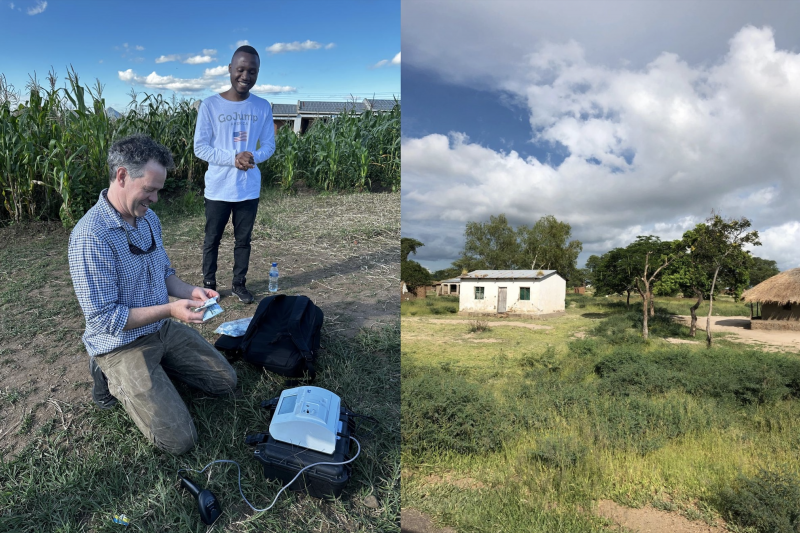
Dr Jack Richards and Nyasha Nguluwe providing a demonstration of the test platform in a rural location in Chiradzulu, Malawi (left image), and a view of rural Malawi (right image).
The team are collaborating with Malawian health services, community organisations and research institutes, to better understand the diagnostic landscape and regulatory requirements needed for the test to be broadly used in the country.
Health services in Malawi typically offer syphilis screening using lateral flow devices, similar to those used for rapid COVID-19 tests.
“While lateral flow tests for syphilis are a great example of how diagnostic innovations can make an impact in low-resource settings, they often return a positive result for people who have previously recovered from the disease and no longer have an active infection,” said Dr George Taiaroa.
The team’s proposed molecular test only returns a positive result for people with an active infection, guiding efficient treatment.
“By accurately screening for the disease, this new device can enable healthcare workers to appropriately treat pregnant women who have the greatest risk of transmitting syphilis to their unborn baby,” said Nyasha Nguluwe.
Looking ahead, the project team will regularly meet with collaborators and work towards a formal trial to evaluate the device relative to current best-practice diagnosis methods. The team is exploring further funding to support the continuation of this work, with this initial effort providing a strong foundation.
“I think it has been really valuable to work with my teammates from the University of Melbourne and to meet with those who will help make the project a reality on the ground,” said Nyasha Nguluwe.
“It will take a sustained collaborative effort to build on this and successfully improve health practice, and I look forward to continuing our work together to bring this project to life.”
The project was established during the inaugural Faculty of Medicine, Dentistry and Health Sciences Impact Health Catalyst Program, which tasked teams of students and researchers from the University of Melbourne and the Kamuzu University of Health Sciences to co-design and pitch innovative proposals aimed at reducing maternal and new born mortality rates in Malawi.
Participants engaged in a series of in-person workshops and mentoring sessions that supported the development of their proposals and discussed how social entrepreneurship, or applying commercial strategies to drive social impact, can help them respond to complex global health challenges.
“Some health researchers fear that taking their ideas to market could potentially withhold new treatments from patients in low-resource settings. However, there are many great examples of social enterprises that are rapidly rolling out new innovations to those who need them most,” said Professor Lauren Ayton AM, Associate Dean Innovation and Enterprise.
“These success stories and the outcomes of this program demonstrate the value of thinking about commercial considerations like scalability and sustainability when responding to complex health challenges, to ensure that any new health innovations can make a lasting impact.”
The program will return later this year, and staff can learn more by visiting the innovation and enterprise website.