University of Melbourne researchers in global collaboration to track carbon emissions in healthcare
University of Melbourne researchers from the Healthcare Carbon Lab in the Faculty of Medicine, Dentistry and Health Sciences have joined a global collaboration to track carbon emissions in healthcare.
Professor Forbes McGain, Dr Scott McAllister and Catherine O’Shea, representing the University of Melbourne, have joined with The Lancet Group, National University of Singapore, National Institute for Environmental Studies (NIES) of Japan, Northeastern University, University of Melbourne and the Health Intervention and Technology Assessment Program of Thailand to create the Lancet MedZero open-access platform.
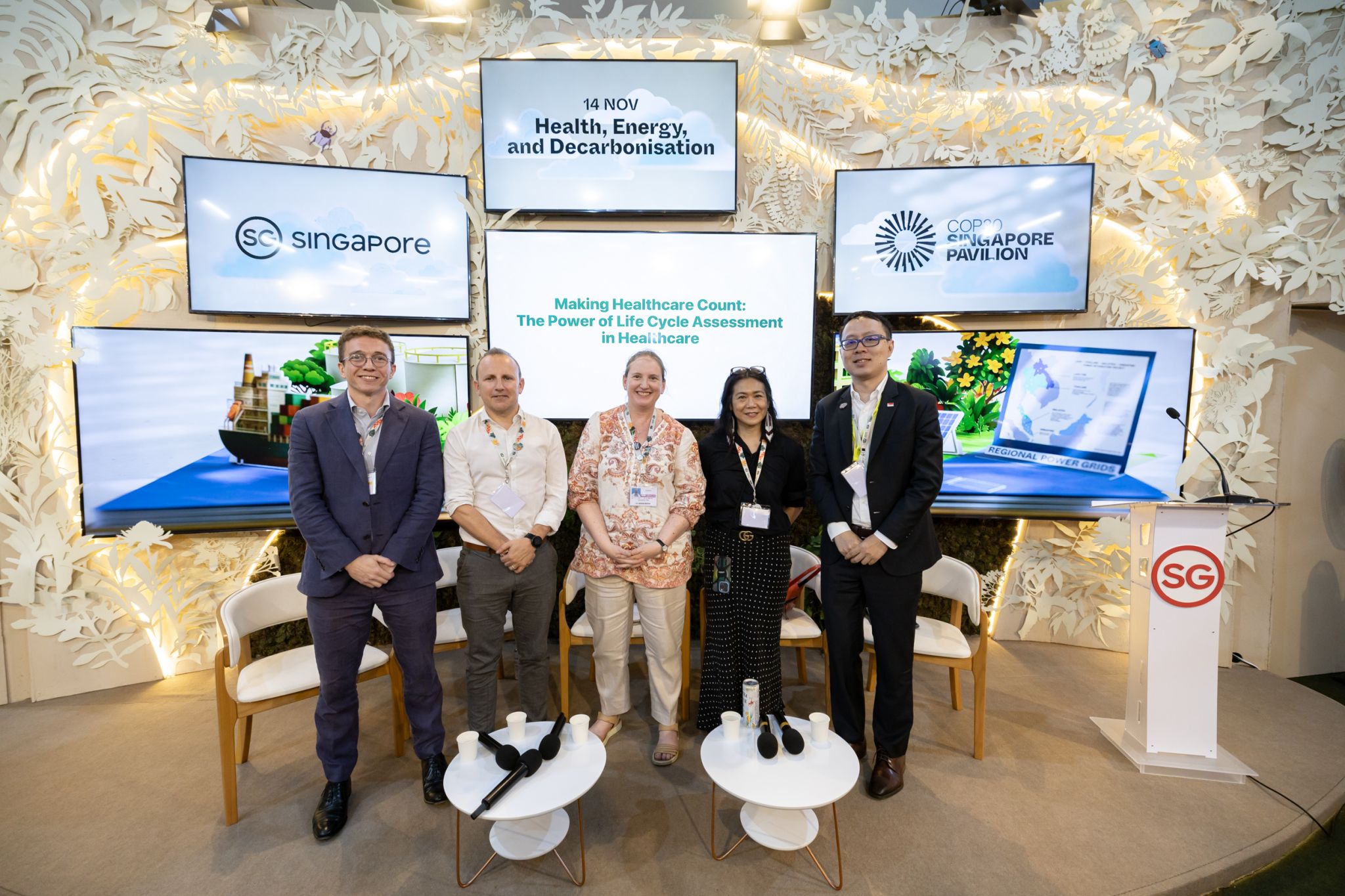
The Lancet MedZero was officially launched at COP30 in November and will be freely available worldwide mid-2026, to help healthcare professionals, teams and organisations measure, track and reduce the carbon emissions associated with healthcare in 2026.
Lancet MedZero will be an open access database, using Life Cyle Assessment (LCA) to quantify the carbon impacts of medical devices, interventions and medicines.
Catherine O’ Shea, Manager at the Healthcare Carbon Lab explains that The Lancet MedZero will serve as a central repository for carbon impact data, critical for integrating sustainability considerations into health technology assessments, clinical guidelines, procurement practices, health system policy-making, and ultimately, day-to-day clinical practice.
“In its full form, the platform will provide the granularity of data needed to design lower carbon and higher quality care pathways, to identify and address emissions hotspots within medical devices and processes and significantly improve the ability of health systems to track decarbonisation progress,” said Catherine O’Shea.
“I’m really proud and excited to be amongst a group of amazing colleagues launching the Lancet MedZero database today,” said Dr Scott McAlister, Director of Research at the Healthcare Carbon Lab, University of Melbourne said.
“This will help a whole range of people from patients, clinicians, health economists and policymakers to shift healthcare towards lower carbon care pathways,” Dr McAlister said.
"Our team from the University of Melbourne are collaborating in this global initiative providing the environmental footprint of healthcare. We are underway obtaining data via spectroscopy to identify what medical devices are actually made from,” said Professor Forbes McGain, Director of the Healthcare Carbon Lab, University of Melbourne.
“With this information healthcare workers worldwide will be able to measure their environmental footprint at work, compare and contrast with alternative approaches, to make scientifically informed improvements to their footprint at work,” said Professor McGain.
The panel that followed brought together leaders who spoke candidly about the scale of the challenge ahead.
They highlighted the hard truths: persistent data gaps, system inertia, and the pressing need for more rigorous and harmonised methods if healthcare is to play its part in keeping a safe climate within reach.
Yet the discussion remained hopeful, grounded in the conviction that with stronger tools, shared standards, and collective commitment, mitigation efforts can move faster and further than before.
Tom Andrew, Head of Health System Carbon Analytics at the National University of Singapore underscored that in a sector responsible for approximately 5% of global emissions.
“This level of transparency is no longer optional; it’s essential,” he said.
The website will launch officially in 2026. Learn more at https://MedZeroCarbon.com
Read the article in The Lancet at https://lnkd.in/gRJcbisZ
More Information
Florienne Denise Loder