Funding sparks innovation and collaboration between researchers from Melbourne and India
The Faculty of Medicine, Dentistry and Health Sciences and the Indian Institute of Technology Kanpur (IITK) have been awarded $600,000 in funding to collaborate on a new MedTech project. The grant, Scheme for Promotion of Academic and Research Collaboration (SPARC), funded by the Indian Ministry of Education supports research into technology such as clinical analysers and biosensing modules. It also supports faculty staff to visit India, and for students from IITK and other Indian universities to come to the University of Melbourne.
 A key focus of the project is to create devices that assist healthcare professionals with patient monitoring, diagnosis and care. These must include cost-effective approaches that consider the resources that are readily available in both countries. The devices will benefit the developing healthcare system in India, and in rural Australia where distance to healthcare facilities is a barrier for many patients.
The investigators from the faculty include Professor Mike McGuckin, Professor Dick Strugnell and Associate Professor Debnath Ghosal, working alongside their Indian counterparts: Professor Sandeep Verma (IITK), Professor Janakarajan Ramkumar (IITK) and Professor Bipin Kumar G. Nair (Amrita University).
Principal Investigator and Head of the IITK’s newly-established Gangwal School of Medical Sciences and Technology, Professor Verma said: “The future of India’s healthcare ecosystem depends on cutting-edge products like portable testing devices, low-cost surgical tools and remote patient monitoring gadgets to serve an ever-increasing demand of rapid diagnosis and quality medical help. Medical devices are essential for accurate and timely diagnosis, safe and effective prevention, quality treatment as well as rehabilitation.”
He explained how IITK will serve as an aggregator to initiate research and facilitate start-ups for a range of point-of-care devices, using its expertise in engineering, technology and health.
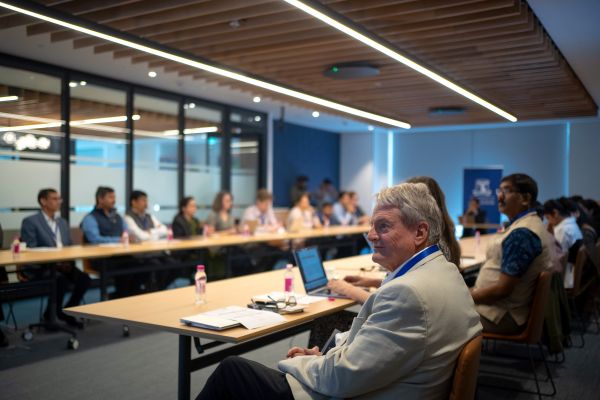
As part of the SPARC program, five researchers from the faculty recently visited IITK for a conference. PhD Student, Shantanu Sen, who participated in one of the SPARC meetings at IITK, said it was truly inspiring: “My own translational research, in thermostable insulin and new strategies targeted for specific hepatic delivery, benefitted from my interaction with biomedical engineering experts during the workshop. It was a great experience to learn about diseases, devices and artificial intelligence in healthcare.”
Professor Strugnell explained that India has a different level of financial risk tolerance compared with Australia, the team hopes this will encourage very innovative and unconventional approaches to solving problems within the project.
“The IITK is already a national hub for Indian entrepreneurship, and we’re excited to be working with our colleagues there. There are many advantages in working across national borders, especially where people work and think differently. Entry into IITK is extraordinarily competitive, and the students are wonderful,” said Professor Strugnell.
The teams have already run successful online workshop, examining antibiotic research in the faculty, and in Kanpur, leading to some interesting exchange of ideas, Professor Strugnell explained.
“This project will be the catalysis of academic 'dyads', where researchers from Melbourne and India become increasingly comfortable and can exchange students and staff for defined periods, so that the research is 'better than the sum of the parts'. It also brings a deeper understanding of a second or third culture in the most populous country in the world, one that is developing very rapidly,” Professor Strugnell said.
The funding supports up to 30 students to visit Melbourne for short research and development sessions, and to learn from academics in areas such as disease biology and biomedical engineering.
Associate Professor Ghosal explained that along with bringing together research teams with complementary expertise, this project will enable student mobility, which is a vital mechanism for knowledge transfer and innovation, creating a globally competent workforce.
The project also showcases the partnership between the Gangwal Medical School of IIT Kanpur and the faculty, which are bound by a five-year MOU for cooperation between academics and research, including curriculum development, and integration of clinical research and training.
SPARC is an Indian government-funded grant scheme that aims to improve the research ecosystem of Indian universities by facilitating academic and research collaborations between Indian Institutions and the best institutions in the world from 28 selected nations to jointly solve problems of national and/or international relevance.