New magnetic mouthguard to combat teeth grinding at night
An innovative new mouthguard could bring relief from a damaging habit affecting millions globally.
Magnets have been used for many years in medical inventions including implantable pacemakers and the revolutionary cochlear implant. Now a new prototype developed by the Melbourne Dental School applies them to one of the most common health complaints: teeth grinding.
Bruxism, the clinical name for grinding or clenching of teeth, affects nearly one in three people and causes side effects including disrupted sleep, jaw pain, earaches, irreversible wear of dental enamel and even changes to the face profile.
“Bruxism is a global problem, affecting patients from ages eight to eighty”, said Dr Naser-ud-Din. “I noticed my own teeth grinding when I was studying dentistry but the plastic splint I was prescribed kept breaking and I ended up fracturing my teeth. This prompted me to find a solution.”
Dr Shazia Naser-ud-Din, researcher at the Melbourne Dental School, has developed the Bruxism Magnetic Splint, (BMS); a wearable device that ensures a natural free space between a patient’s upper and lower jaws.

Dr Shazia Naser-ud-Din, left, with Pro Vice-Chancellor (Research Collaboration) Professor Alastair Sloan, who was previously Head of Melbourne Dental School.
Moving beyond plastic mouthguards
The BMS is designed to replace passive plastic mouthguards, or ‘splints’, that are often prescribed by dentists. For some, these mouthguards are ineffective and can be expensive. Over time they can become brittle and break if worn down by a patient clenching or grinding their teeth. A broken mouthguard can lead to bleeding gums and discomfort, forcing some patients to give up on wearing it all together.
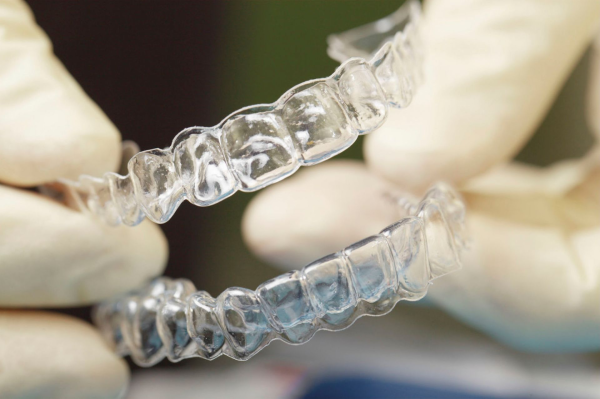 A passive plastic mouthguard often prescribed by dentists. Image: iStock
Tom Harris is one such patient. After grinding his teeth in his sleep, he needed extensive dental work to fix damage to his molars. Cracked teeth, enamel fillings, veneers, damage to neighbouring teeth, a root canal and finally a gold cap, left him with extra stress, pain and out of pocket costs.
“The back of the plastic mouthguard has broken off, and I’m concerned I’ve swallowed it in my sleep. So, I’ve been looking to see what else is out there.”
Active solution for an active problem
Dr Shazia’s invention aims to provide an active solution to counteract the active force of teeth grinding. Her new patented splint positions small magnets embedded within its frame on either side of the last tooth. The magnets are made of an extremely strong rare earth NdFeB which can withstand high force. Although not yet available for purchase, the magnetic device is expected to cost no more than a traditional plastic mouthguard while also being more durable.
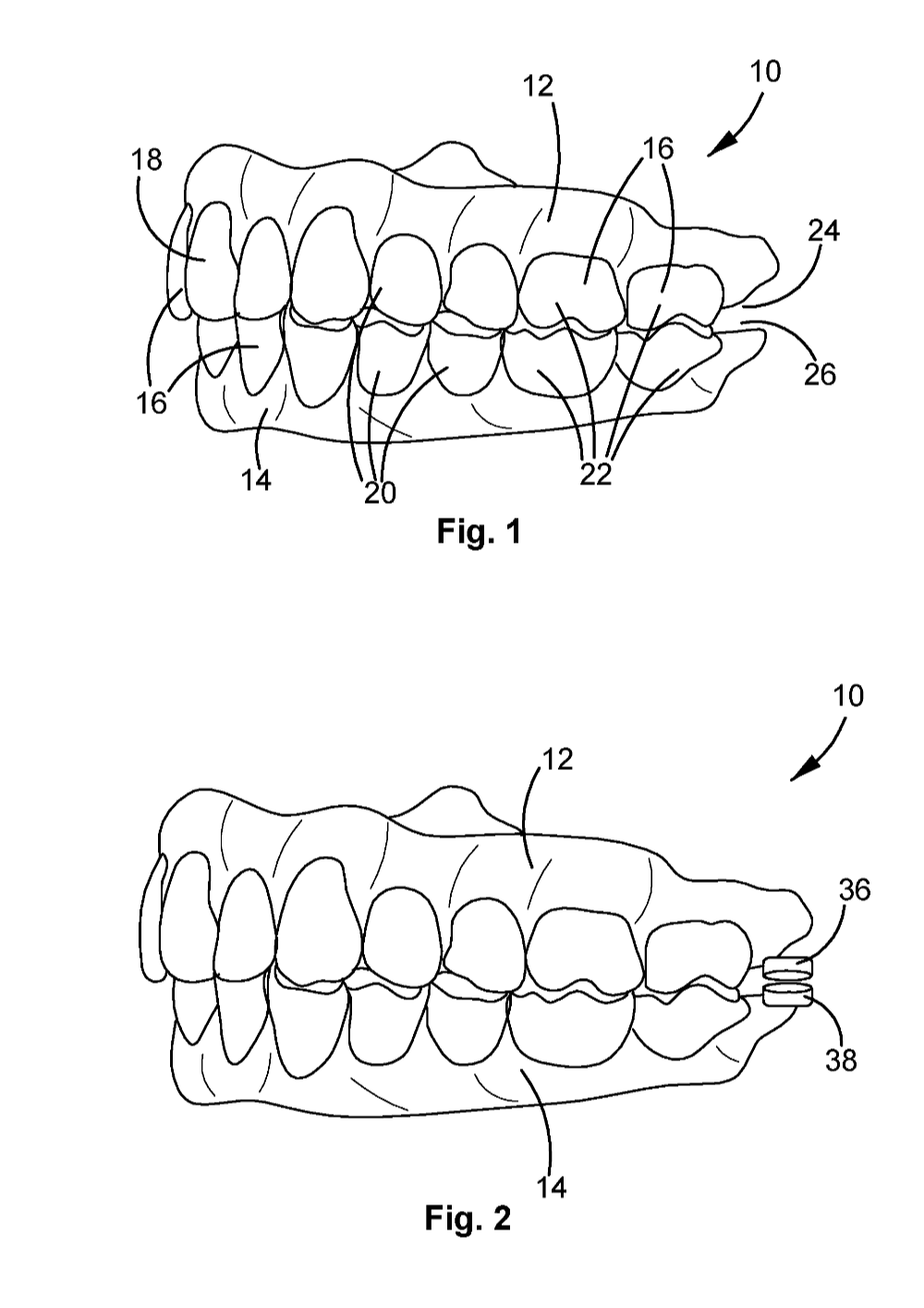
Drawings of the bruxism magnetic splint showing the placement of the magnets at the back of the jaw, where upper and lower jaws meet.
Prototype safety testing is now underway and clinical trials are the next step, said Dr Naser-ud-Din who completed the University of Melbourne’s TRAM program.
“These past three years have been the most fulfilling part of my academic, clinical and research career. The university has been the catalyst for my intellectual ‘Aha!’ moments, effectively switching my cognitive focus toward the high-level innovation required for the future vision of dental technologies,” Dr Naser-ud-Din said.
The device is now in the middle of commercialisation with the hope of securing funding this year. For more information contact ip-mailbox@unimelb.edu.au.