India’s future public health leaders put to the test at University of Melbourne competition
The University of Melbourne welcomed more than 60 students from 11 leading institutions across India to the Melbourne Global Centre – Delhi on Monday to compete in a case competition focused on developing solutions to public health challenges.
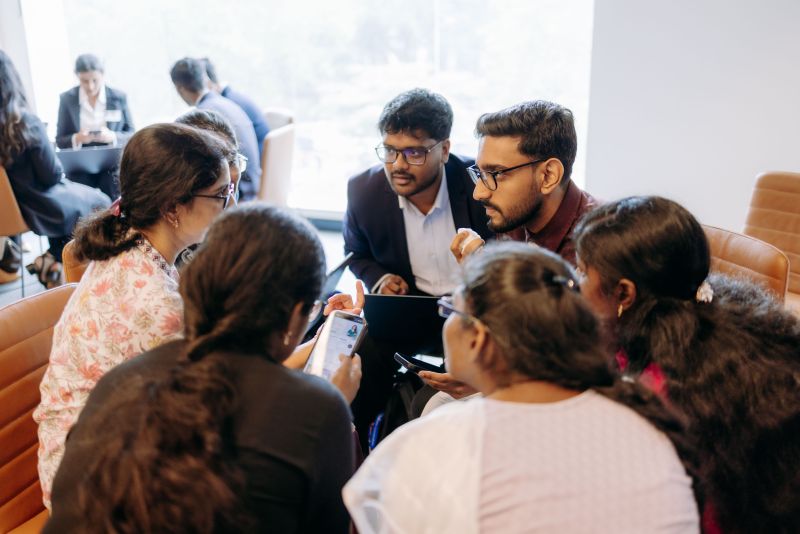
Each team included student studying disciplines spanning medicine to social sciences.
The inaugural India chapter of the Indo-Pacific Global Health Case Competition saw student teams develop innovative, evidence-based strategies to improve vaccine access and uptake among those living with disabilities in India.
Among the participating universities were the Indian Institute of Technology in Kanpur, the All India Institute of Medical Science, the Indian Institutes of Public Health in Delhi and Gandhinagar and the Christian Medical College in Vellore.
Each team included students across disciplines spanning medicine, engineering, commerce and social sciences. They worked together to develop proposals which considered cost-effectiveness, integration with existing infrastructure, and community engagement.
Professor Nathan Grills, Academic Director India for the Faculty of Medicine, Dentistry and Health Sciences and Fellow of the Australia India Institute at the University of Melbourne, says the competition creates a space for collaboration.
“As public health practitioners, we need to work with different people and across multiple sectors to ensure we design and deliver interventions that successfully improve health outcomes,” he said.
“Working in multidisciplinary teams therefore not only provides an immersive experience for the students, it also demonstrates the innovative, high-impact solutions that are possible with this kind of collaboration.”
“This competition is setting up a platform for students from leading universities to come together and help shape the future of public health and disability inclusion in India.”
Each team presented their proposals in front of an expert judging panel. First place (Specialist Trainee Category) was awarded to a team from the Manipal Academy of Higher Education, who proposed a pilot program in Madhya Pradesh that would connect India’s national disability and immunisation registries to help identify at-risk households in the region.
The program would then establish three ‘reach tiers’ mapped against four immunisation delivery modes ranging from in-clinic vaccination to home-visit services, while also conducting an audit of clinics based on national accessibility standards.
Along with the team from Manipal Academy of Higher Education, the top three teams (Non-Specialist Trainee Category) from the Christian Medical College in Vellore, the Rajagiri College of Social Sciences and St John's Medical College were awarded cash prizes.
A last-minute twist was introduced where the judging panel added a requirement for each presentation to be accessible for the vision-impaired, after it was revealed one of the judges was blind.
“This encouraged students to put the principles of accessibility and inclusion into practice and reinforced the need to actively consider and remove barriers in every aspect of our work to create equitable health systems,” said Professor Grills.
The competition was organised jointly by the University of Melbourne’s Faculty of Medicine, Dentistry and Health Sciences and the Australia India Institute and marks a new frontier for the university’s existing Indo-Pacific Global Health Case Competition held annually in Melbourne.