Future health professionals getting their hands dirty
On 16 and 17 July, students and staff from the Faculty of Medicine, Dentistry and Health Sciences and the Faculty of Science at the University of Melbourne spent two days at Dookie campus for a PLANT project field trip. They planted Indigenous species, learned from Yorta Yorta Elder Lee Joachim about caring for Country, and collected data on the paddock trees that shelter wildlife and store carbon.
Facilitated by Lee Joachim, Dr Jess Abbonizio, Dr Catherine O'Shea, Professor Forbes McGain, Associate Dean Healthcare Sustainability, Rachael Miller, Sophie Roberts and Ainslie Macdonald, together with the Yorta Yorta Nation Aboriginal Corporation and Outback Academy Australia, the aim of the PLANT project, was for every future doctor, dentist and health scientist to graduate with the insight that ecosystems shape everything from clean air and food security, to disease patterns and mental wellbeing.
They started their trip with an insightful session with Lee Joachim, Yorta Yorta Nation Aboriginal Corporation Elders Chairperson learning about his connection as a Yorta Yorta man to his Country, the seasons, the animals and plants.
Staff and student participated in a guided tour around the campus and surrounds including the bushland reserve and heard from Outback Academy local Dookie community member, Andrew Evans, talk about the history of the landscape, the biodiversity and challenges of introduced species for the land. There was also a session from educators about biodiversity, climate, sustainability and health.
Then everyone got their hands dirty planting native and Indigenous plants to the local area, such as Acacia dealbata – Silver Wattle, Callitris glaucophylla – White Cypress Pine, Eucalyptus albens – White Box and Eucalyptus camaldulensis – River Red Gum. These trees will offer much needed shelter, food and habitat for local wildlife, including over 27 bird species we observed during our trip, including the Australian King Parrot, Flame Robin , Red-rumped Parrot and White-plumed Honeyeater.
They finished by collecting data on the health of Dookie’s paddock trees — which are important for wildlife habitat and food sources, soil health, as well as shade and shelter for animals. Students and staff collected data on trees’ condition, and presence of biodiversity assets like tree hollows to deepen students’ understanding of the value of trees around the campus.
Second year medical student Zara Boubouras enjoyed getting her hands dirty during the tree-planting activity.
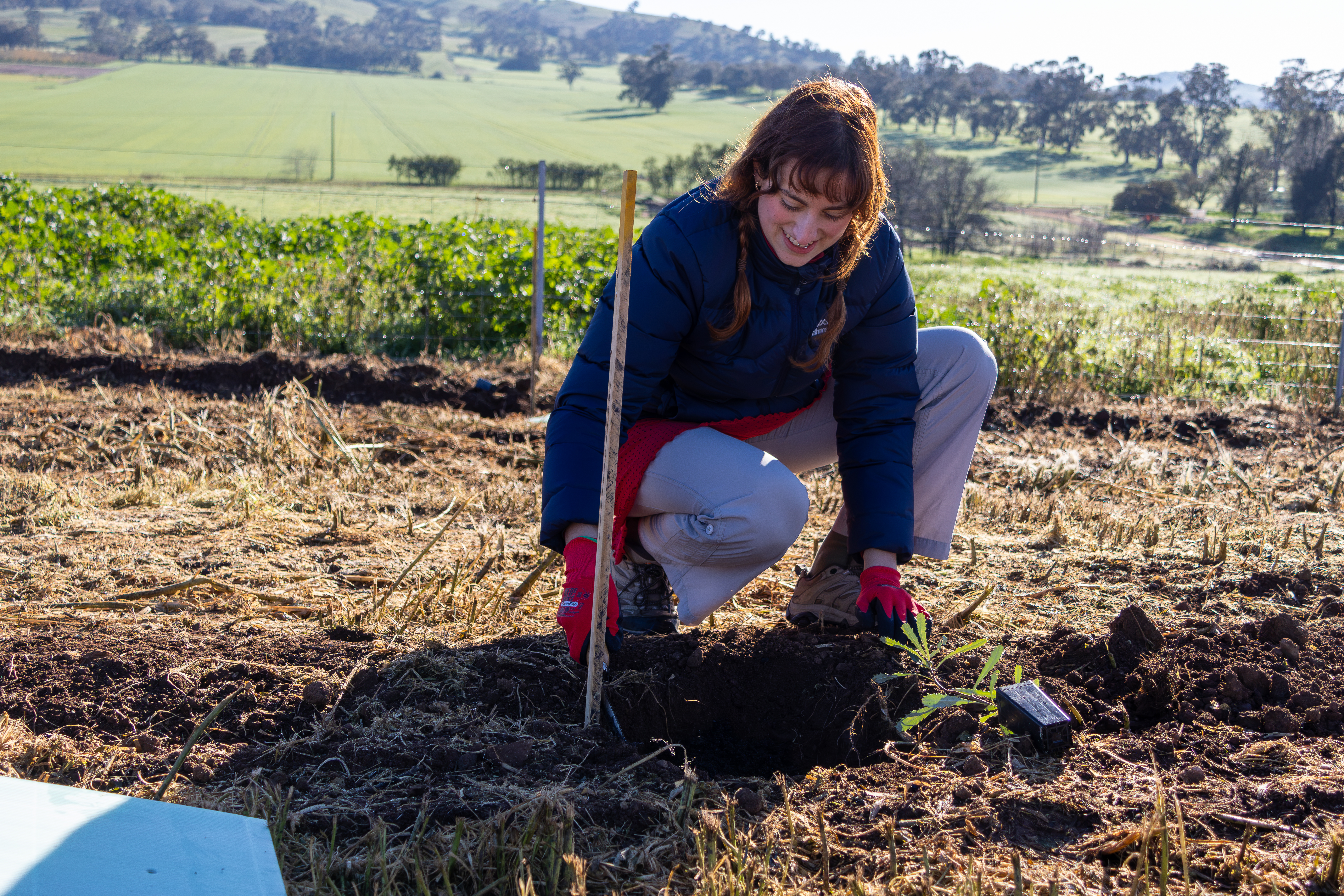
"It was good to get my hands dirty, metaphorically and physically. We learn about biodiversity and health, but it has never actually been physically in front of me. Healthcare has a big impact on the environment, and I think it's really important to take steps towards changing the status quo."
"It's been a great experience. I think the really what has brought a smile to me really more than anything is the student engagement," said Professor Forbes McGain, Associate Dean Healthcare Sustainability.
Professor Forbes McGain reflected on his hopes to expand the program across the health sector, to communicate the importance of supporting biodiversity for health:
"I've been thinking a lot about how do we actually make this a bigger thing, whereby we engage with many more health care students but also health care professionals doctors nurses and others, who are actually working in hospitals and in clinics around the country, to make this concept that biodiversity and trees are really important for us, for Australia and for the world as we move into a more challenging times from climate change and biodiversity loss?" Professor McGain said.
Associate Professor Stuart Barber, in the School of Veterinary and Agricultural Sciences in the Faculty of Science, who has taken students out to the Dookie campus for more than 20 years, is convinced of the benefits of getting students into a regional area to see how things are grown, how food and fibre are managed and how the natural landscape supports that.
"I think the great thing is seeing students really interacting and being engaged in that natural landscape and understanding how that works. So it's always really enjoyable to see that interaction. I know the joy and what that brings out in students is I think really important. Having this sort of experience is really useful for all Faculties.”
The project was co-funded by the Melbourne Biodiversity Institute, the University of Melbourne Campus Living Lab Accelerator, and the Faculty MDHS.