Faculty called to be ‘All in’ during Reconciliation Week
Recently the Faculty Medicine Dentistry and Health Sciences Indigenous Development and Truth Telling in Health teams hosted a panel discussion and Q&A with Faculty and School leaders on the theme “All in": Truth-Telling and Reflections on Dhoombak Goobgoowana. It was an opportunity to critically appraise what real commitment to reconciliation looks like for a health faculty in a major university.
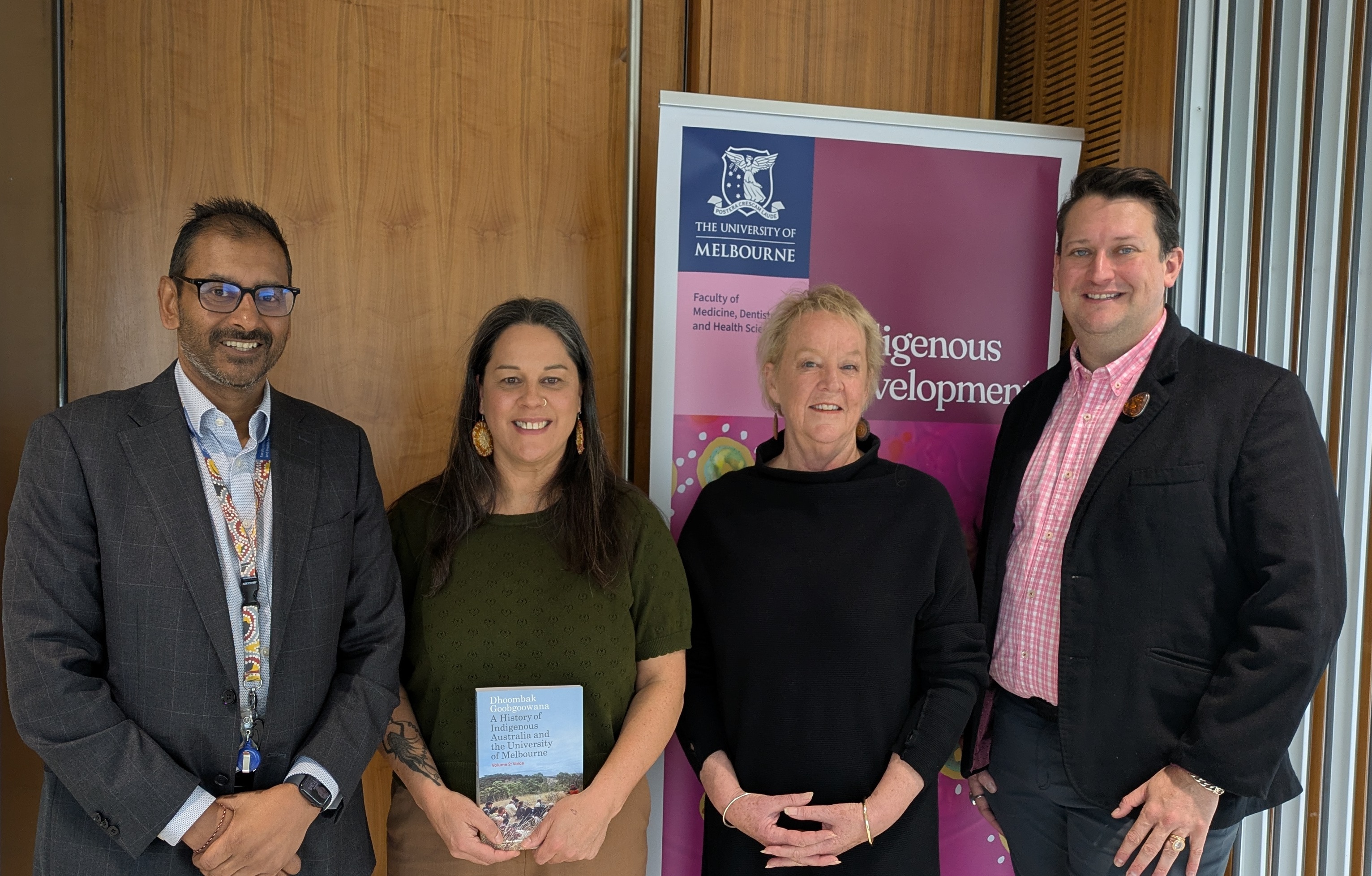
Moderated by journalist and broadcaster Dan Bourchier from National Indigenous Television, the panel featured Professor Shawana Andrews, Director of the Poche Centre for Health and Associate Dean Indigneous, Professor Sarath Ranganathan, Head of the Melbourne Medical School and Professor Julie Satur, Melbourne Dental School.
Professor Mike McGuckin, Acting Dean of the Faculty of Medicine, Dentistry and Health Sciences said the theme “All in” calls for collective responsibility and sustained engagement with truth-telling and reconciliation.
“We recognise that the Faculty’s foundations are deeply intertwined with colonial practices of dispossession and with knowledge systems that sought to erase Indigenous life, knowledge and authority. Reconciliation requires us all to face the truth of historical involvement in scientific racism and eugenics, as revealed through the book Dhoombak Goobgoowana,“ he said.
He said reconciliation requires ongoing action, not reflection alone. “Reconciliation starts with truth-telling and must be followed with sincere, informed and meaningful actions.”
In education, Professor Julie Satur highlighted work embedding Indigenous knowledges in the curriculum, including the development of the National Dental Aboriginal and Torres Strait Islander cultural safety curriculum, the appointment of a lecturer in First Nations Health and critical research about cultural safety in dentistry and oral health.
“We are creating the health workforce of the future. It is important for our students to see the structural inequities . If our students are not thinking that way, we are replicating the biomedical model,” she said.
Professor Shawana Andrews reflected on changes in Indigenous representation across the faculty and the importance of confronting institutional history.
“When I started teaching 13 years ago, I was the only Indigenous staff member in Health Sciences. Now we have academics and teams in every school. The work of Sarath and Julie alleviates the heaviness placed on Indigenous academics. The book Dhoombak Goobgoowana acknowledges harms to Indigenous peoples. This is the first step of truth-telling. The next step is naming and dismantling the systems that created the harms in the first place. This work must reinstate the authority and voice of Indigenous peoples who have been silenced by such systems. But we must not erase history; retaining the record is very important. It creates a willingness to engage in difficult spaces," said Professor Shawana Andrews.
In research, Professor Andrews spoke about supporting Aboriginal and Torres Strait Islander PhD candidates to lead community-driven research.
“Indigenous students have a choice now. Once upon a time, this institution was not available to mob. They now have access and can pick the right university for them. They can vote with their feet and it’s our responsibility to ensure we are an educational institution that upholds Indigenous knowledges and values.”
Professor McGuckin said reconciliation means ensuring that research questions arise from community; research is co-designed with community; data is owned by community and results come back to benefit Indigenous communities and pointed to the Victorian Aboriginal Health, Medical and Wellbeing Research Accord, developed by the Victorian Aboriginal Community Controlled Health Organisation (VACCHO) ‘marra nngarrgoo, marra goorri’ as a guide for ethical research practice.
Professor Julie Satur emphasised the importance of recognising the expertise Indigenous people bring in their own lives.
“We bring ways of working that shut down individual voices. So, I think it’s about flipping this. In my world, it’s thinking about what the person brings to the consultation.”
The panel also discussed equity in healthcare and the responsibility of institutions to move beyond statements into practice.
“We are powerful, with many partners and Indigenous communities are looking to us for support. In terms of health, it’s just the right thing to do. We are saying the right things, but are we doing the right things?" Professor Ranganathan said.
Learn more about events taking place at the University of Melbourne during Reconciliation Week.