Since 2012, The University of Melbourne's Faculty of Medicine, Dentistry and Health Sciences researchers have collaborated with international academic colleagues at Oxford University's Clinical Research Unit (OUCRU) to investigate the intractable disease of tuberculosis (TB) prevalent throughout Vietnam.
OUCRU is a large-scale clinical and public health research institute with facilities in Vietnam, Indonesia and Nepal. In Vietnam, OUCRU's main hospital partner is The Hospital for Tropical Diseases and for TB Research, Pham Ngoc Thach Hospital.
Associate Professor Sarah Dunstan, an expert in human and pathogen genomics of infectious diseases, is leading the University of Melbourne's partnership with OUCRU. Associate Professor Dunstan's Melbourne-based colleagues working on this partnership are Dr Xuling (Shirley) Chang and Dr Matthew Silcocks.
The Melbourne-based TB researchers collaborate closely with Associate Professor Nguyen Thuy Thuong Thuong and her team at OUCRU Vietnam. Their association has been long and productive. Associate Professor Dunstan supervised Associate Professor Thuong's doctoral thesis, and she has been working with her since 2001 at OUCRU in Ho Chi Minh City. In 2012, when Associate Professor Dunstan relocated to the University of Melbourne, their close collaboration flourished.
Associate Professor Thuong leads a highly productive TB research group and is currently focusing her research on improving TB diagnosis and treatment by performing clinical trials. She uses cellular models and omics technologies to understand how host and pathogen influence treatment outcomes.
International collaboration advancing better local, regional and worldwide health outcomes
For over twenty years, OUCRU Vietnam has led human clinical studies of TB with high-quality multidisciplinary research, centred around well-defined cohorts of patients enrolled in randomised and controlled clinical trials and community-based observational studies, with long-term support from the Wellcome Trust.
In 2021, the Australian and Vietnamese researchers joined with colleagues from the United States of America (USA) and Uganda to form a multidisciplinary team of experts to gain new knowledge of the disease, discover new avenues to control the spread of TB and improve patient outcomes. The team's research has flow-on benefits for patients with tuberculosis worldwide.
International funding bodies have recognised the partnership's clinical trials and track record of using clinical data and patient samples to answer questions related to the human and pathogen genomics of TB.
Funding was awarded by the National Health and Medical Research Centre (NHMRC) in the 2012 and 2020 rounds, followed by a National Institute of Allergy and Infectious Diseases grant in 2021.

OUCRU Vietnam laboratory tour during last year’s annual meeting for the group’s NIH TBRU (TB Research Unit) grant in September
Advancing a fundamental understanding of tuberculosis
The University of Melbourne is working in partnership with OUCRU Vietnam to deliver three primary projects assessing genetic variations in the host and pathogen of tuberculosis. This involves:
- Genome-to-genome analyses of pulmonary tuberculosis in Vietnam, using a paired host and pathogen genomic dataset
- Discovery of human genes contributing to TB susceptibility, assessing common and rare variants associated with pulmonary and meningeal TB
- Identification of bacterial genetic variation associated with disease transmission and drug resistance through interrogation of genomic signals of evolution.
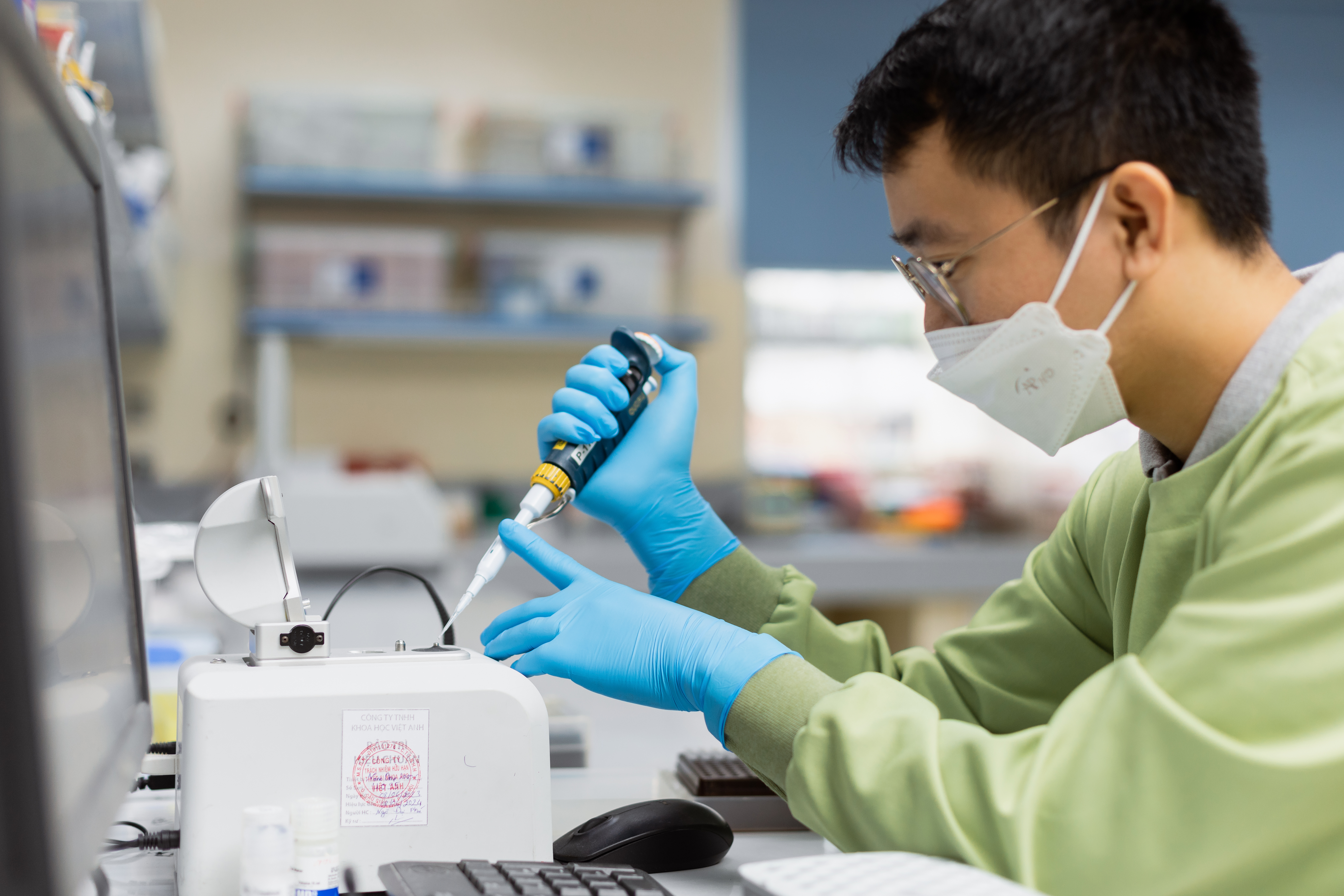
TB researcher in OUCRU Vietnam labs
Driving innovation to control a TB epidemic locally and internationally
The World Health Organization has determined that new tools—including vaccines, drugs and treatment regimes, and point-of-care testing—are crucial to achieving a 95 per cent reduction of TB deaths by 2035.
Accordingly, this collaborative team uses genomic technology to generate new knowledge to aid the design of new vaccines and drugs, relying on extensive clinical and genetic cohorts from Vietnam. This fundamental research to discover genetic determinants of TB disease is a crucial building block in the challenge of significantly improving TB patient outcomes in the local region and worldwide.