New telehealth tool to simplify and support patient-friendly communication launched nationally
A new digital health application, developed by an interdisciplinary team of digital health researchers led by Monash University, is strengthening telehealth delivery by enabling healthcare practitioners to turn complex medical advice into clear, accurate written consultation summaries in real-time for patients across Australia.
The Centre for Digital Transformation of Health supported this project by conducting a clinical simulation study in The Validitron, our digital health simulation environment. This work helped identify usability and workflow issues early, strengthening the application before clinical testing and national rollout.
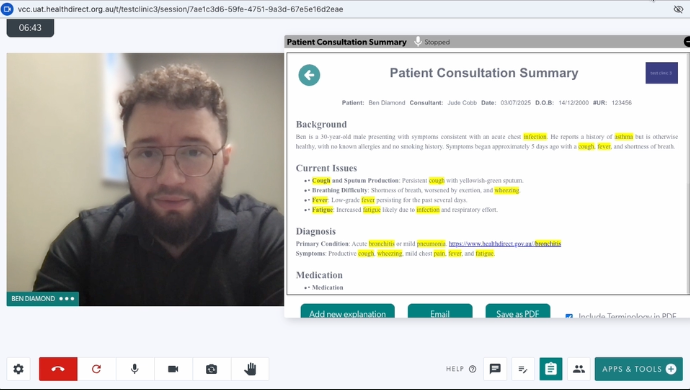
Developed through a multi-partner collaboration brought together by the Digital Health Cooperative Research Centre (DHCRC), in partnership with Monash University, Healthdirect Australia, the Department of Health Victoria, Monash Health, and the University of Melbourne, the Patient Consult Summary (PCS) application represents a significant step forward in improving the virtual healthcare experience for patients and healthcare providers.
The PCS application allows healthcare practitioners to collaboratively prepare and share a concise summary of information discussed during a consultation with patients.
Summaries are created by healthcare practitioners in real time using typing or talk-to-text functionality and are automatically formatted for secure delivery to patients.Importantly, the summaries are supported by plain-English explanations of medical terminology sourced from Healthdirect knowledge graph of information, helping patients better understand their condition and next steps in care.
Led by Professor Rashina Hoda from Monash University’s Faculty of Information Technology, the project involved a series of experience-based co-design studies, iterative software prototyping, and evaluation studies that were implemented in virtual and real-world settings to develop the PCS application.
Professor Hoda remarked that the project highlights the importance of evidence-based digital health innovation.
“Our research and development demonstrated that providing patients with immediate, written summaries with medical terminology explanation significantly improves understanding and continuity of care,” Professor Hoda said.
“By focusing on what patients told us they needed – clearer information, better understanding, and support beyond the consultation, this collaboration has delivered a tool that strengthens virtual care while maintaining clinical safety, data privacy, and quality.”
Dr Mahima Kalla, from the University of Melbourne’s Centre for Digital Transformation of Health, said the PCS application’s clinical simulation provided a safe environment to de-risk and strengthen the digital innovation before progressing this new technology to real-world clinical testing.
"Through simulation, we were able to observe how the tool might work in clinical practice and identify and mitigate potential points of frustration which may impact usage in the real-world," Dr Kalla said.
The simulation study was followed by a clinical evaluation of the application at Monash Health by the project’s clinical lead, Associate Professor Peter Poon and his team.
“It was our real privilege to be able to help patients and their carers—especially those who are more vulnerable—gain a better understanding of their consultations through the real-time sharing of consultation summaries, strengthen shared decision-making, share information with family and healthcare providers, and improve communication with their treating team,” Associate Professor Poon said.
Based on the learnings from the co-design, simulation, and clinical evaluation sessions, Professor Hoda’s team iteratively developed and refined the software application directly on Healthdirect Australia’s testing environment before handing it over to their team for further refinements and deployment on their live platform.
During the project, seven health services across Victoria were involved in trialling and testing of the application in the early release phase from March 2025 to December 2025.
After successful development and validation, the PCS application has now been scaled for national rollout and is available to all healthcare practitioners, including doctors, nurses, allied health professionals and specialists in Australia for use on the Healthdirect Video Call platform.
Healthdirect Australia is the national provider of virtual health services. The PCS application integrates directly with Healthdirect’s Video Call platform, a secure and scalable service used across hospitals, community health centres, general practices, allied health settings and virtual emergency departments.
Healthdirect Australia Service Director Mr Sam Georgy said the PCS application is part of the organisation’s broad program of innovation for the Video Call service.“Our role in the health system is to use fit for purpose technology to connect patients to quality healthcare where and when they need it. We are proud to be involved in research partnerships that bring good ideas like the PCS application to life,” Mr Georgy said.
“This project shows how co-designed research can be translated into real-world impact for both end-users – the clinicians and their patients.“As Video Call consultations continue to increase across the country, we are very excited to see this application supporting stronger virtual care adoption and an enhanced experience across all our users, in a range of clinical settings.”
International evidence confirms that after-visit summaries improve patient understanding and self-management. Co-designed with Healthdirect, the PCS application represents a locally developed and governed solution tailored to Australian healthcare settings.
DHCRC CEO Annette Schmiede said the sustained increase in demand for telehealth services since COVID-19 has highlighted both its value and the importance of evidence-led implementation.
“Telehealth plays a critical role in improving access to care, particularly for people who face barriers to in-person services or who live in regional and remote communities,” Ms Schmiede said.
“As use continues to grow, research is essential to ensure these models of care are implemented safely and deliver meaningful impact at scale.”