New study makes the case for clinical simulation in digital health innovation
Researchers at the Centre for Digital Transformation of Health are recommending clinical simulation as a method for testing and refining digital health technologies.
The recommendation comes after using the approach to successfully identify and resolve usability issues in a new telehealth tool designed to enable healthcare practitioners to turn complex medical advice into clear, accurate written consultation summaries in real-time for patients across Australia — before it was ever tested in the real world.
The study, published in npj Digital Medicine, demonstrates how clinical simulation can de-risk real-world deployment and optimise digital health innovations at a critical stage in their development.
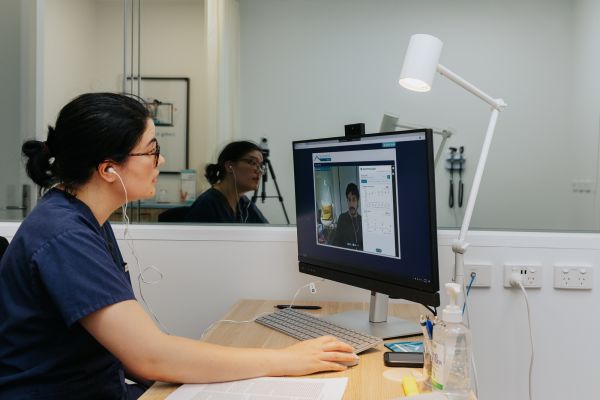
A persistent challenge for digital health innovators is that traditional research methods often fail to identify socio-technical problems – such as poor workflow fit or usability barriers – early enough to address them before a technology reaches real patients.
"Clinical simulation gave us a psychologically safe environment to stress-test our technology and identify problems we might never have caught until it was too late,” said co-lead researcher Dr Teresa O’Brien, from the Centre for Digital Transformation of Health.
“That's especially important when your end users include people with serious illness."
The team used clinical simulation to evaluate a Consultation Summary Application (CSA) – a tool designed to generate real-time, patient-facing summaries during video telehealth consultations for patients with complex conditions, such as palliative care patients. Seven clinician–simulated patient pairs took part in mock consultations based on a metastatic lung cancer scenario, conducted through the Centre’s clinical simulation laboratory.
Both clinicians and simulated patients, exposed to the technology for the first time, perceived the CSA as a valuable tool to support information recall and self-management, with clinicians rating overall acceptance at 74 per cent and simulated patients rating the summary outputs at 94 per cent on average.
Crucially, the simulations surfaced a range of usability and workflow issues that were addressed before real-world testing proceeded.
"Each simulation session gave us actionable insights we could feed straight back into the development process. By the time we're ready for real-world testing, we have far greater confidence the tool will actually work in practice," said Dr O'Brien.
Insights from each simulation session directly informed improvements to the application, including:
- Making voice dictation optional via a toggle button
- Adding rich text formatting and medication tables to improve clarity for patients
- Enabling clinicians to email summaries directly to patients instead of relying on patients to download it themselves
- Introducing a character limit on medical definitions to improve readability and salience of the actual medical summary
- Allowing clinicians to resize the patient video window during consultations so they can focus more on the patients
The researchers argue their approach has broad applicability for the digital health sector, and offer practical guidance for other innovators considering clinical simulation – including the importance of multiple rehearsal rounds, dedicated technical support, and building in time between sessions for iterative refinements.
"We recommend clinical simulation to any digital health innovator looking to de-risk real-world deployment. It's a rigorous, ethical, and practical way to optimise a technology before it reaches patients," said Dr Kit Huckvale, Acting Director of the Centre.
The CSA is now being prepared for real-world clinical testing with palliative care patients.
The research was supported by the Digital Health Cooperative Research Centre (DHCRC), Monash University, HealthDirect Australia, Monash Health, the University of Melbourne, and the Victorian Department of Health.